
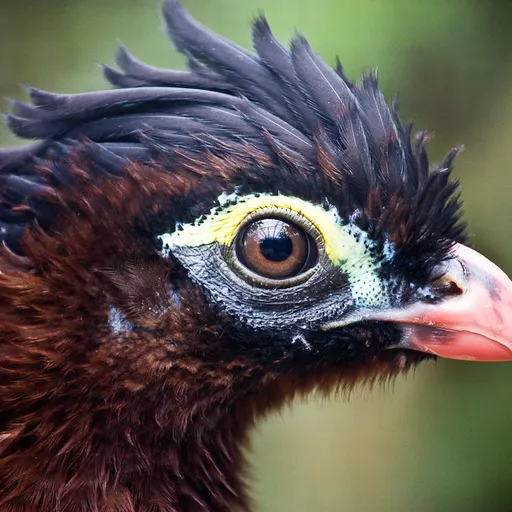
Nocturnal Curassow
Nothocrax urumutum
Least Concern
Overview
The nocturnal curassow (Nothocrax urumutum) is a species of bird in the family Cracidae, found across several South American countries. It is the smallest of the curassows and the sole member of its genus.
Identification
- Size: 50 to 57.5 cm long, with a recorded weight of 1,250 g.
- Plumage: Mostly rufous and chestnut, distinct from the mostly black plumage of other curassows; features a flat, blackish crest and buffy ventral area.
- Markings: Brownish-orange eye surrounded by bare skin (greenish-yellow above, black below); reddish-orange bill; gray legs; tail feather tips are paler than the rest.
- Song: A series of seven, low-pitched, highly resonant notes rendered as 'hmm-hmm-hmmmm, hmm hmm-hmmm, hmmph!', sung exclusively at night.
Habitat
Found in middle and upper Amazonia, ranging from far southern Venezuela and southeastern Colombia through eastern Ecuador and northeastern Peru into western and central Brazil. It inhabits terra firme and both permanent and seasonal flooded forests, favouring low-lying, gentle terrain often near blackwater rivers. Typically found below 850 m, though recorded as high as 1,500 m in Ecuador.
Diet
Forages singly or in groups of up to four birds at dawn, dusk, and the few hours around them. It feeds on the ground on vegetable matter, though its diet has not been extensively studied.
Did you know?
Despite its name, the bird is active during daylight as well as night and twilight, though it sings only at night. Its mostly nocturnal habits likely contribute to it experiencing less hunting pressure than other Cracids, leading to its 'Least Concern' conservation status.
Sources
- Wikipedia · CC BY-SA 4.0
- Wikidata · CC0 1.0