
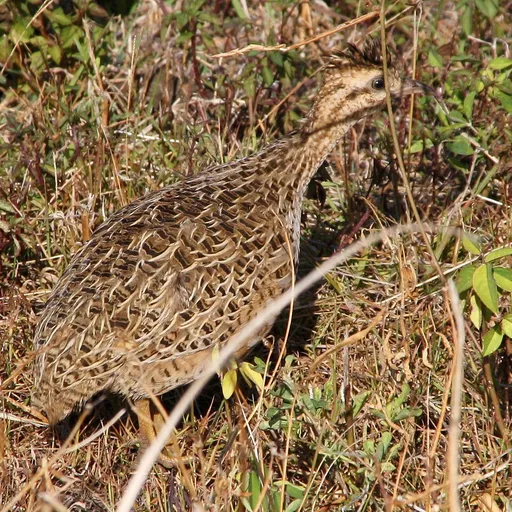
Chilean Tinamou
Nothoprocta perdicaria
Least Concern
Overview
The Chilean tinamou (Nothoprocta perdicaria) is a tinamou species commonly found in high-elevation shrubland in the subtropical regions of central Chile. It belongs to the family Tinamidae and is one of the closest living relatives to other ratites, such as ostriches and emus, yet retains the ability to fly short distances.
Identification
- Approximately 29 cm long with a stocky body and an almost tail-less appearance due to a short tail and drooping coverts.
- Buffy face featuring a drooping dark eyeline and a small cheek strip, with a brown neck marked by dark spots on the lower section.
- Grey chest with complex streaks (or brownish in southern populations) and upper body plumage that appears striped but is more complex in detail.
- Thick, short, pale yellowish legs and a curved bill similar to that of the California quail.
- Loud, double-syllabled 'sweee weee' stride whistle; under stress, it produces a lowering series of whistles accompanied by fast wing sounds.
Habitat
Found in high-elevation shrubland between 400 and 2,000 m, as well as arid mountain forests associated with Acacia caven, Porlieria chilensis, and Jubaea chilensis. Its range covers all of Chile except the southern Los Lagos, Tarapacá, Antofagasta, Aisén, and Magallanes y Antarctica Chilena regions, and it has been introduced to Easter Island.
Did you know?
The female lays 10–12 glossy eggs in a scrape, which the male incubates for 21 days and covers with feathers when unattended. The chicks are buff with dark stripes and begin running shortly after hatching, capable of flight when only half-grown.
Sources
- Wikipedia · CC BY-SA 4.0
- Wikidata · CC0 1.0