
Stitchbird
Notiomystis cincta
Vulnerable
Overview
The stitchbird or hihi (Notiomystis cincta) is a small, honeyeater-like bird endemic to the North Island and adjacent offshore islands of New Zealand. It is the sole member of its own family, the Notiomystidae, and is currently classified as Vulnerable on the IUCN Red List. While rare and extirpated from most of its former range, it persists on Little Barrier Island and has been reintroduced to several island sanctuaries and mainland locations.
Identification
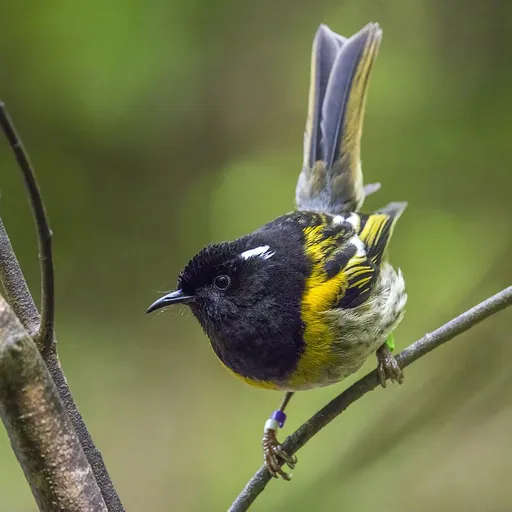
- Males possess a dark velvety cap with short white ear-tufts, a yellow band across the chest, and a grey body, while females and juveniles are duller, lacking the black head and yellow chest band.
- The bill is thin and somewhat curved, featuring a long tongue with a brush at the end for collecting nectar and thin whiskers projecting from the base.
- The most common call is a 'tzit tzit' sound, which is believed to be the source of the bird's common name, alongside a high-pitched whistle and a nasal alarm call.
Habitat
The stitchbird is endemic to the North Island of New Zealand and its adjacent offshore islands. It was historically widespread but is now restricted primarily to Little Barrier Island, with reintroduced populations on Tiritiri Matangi Island, Kapiti Island, Zealandia, Maungatautari, Bushy Park, and Lake Rotokare.
Diet
The main food source is nectar, supplemented by small insects and a diverse range of fruits including Coprosma, five finger, pate, tree fuchsia, and raukawa. Important nectar sources include haekaro, matata, pūriri, rātā, and toropapa. The bird rarely lands on the ground and avoids large canopy trees where it faces interspecific competition from tūī and New Zealand bellbird.
Did you know?
Stitchbirds are the only bird species known to mate face to face rather than in the conventional copulation style where the male mounts the female's back. They also exhibit some of the highest levels of extra-pair paternity of any bird, with up to 79% of chicks in a nest potentially sired by other males.
Sources
- Wikipedia · CC BY-SA 4.0
- Wikidata · CC0 1.0