
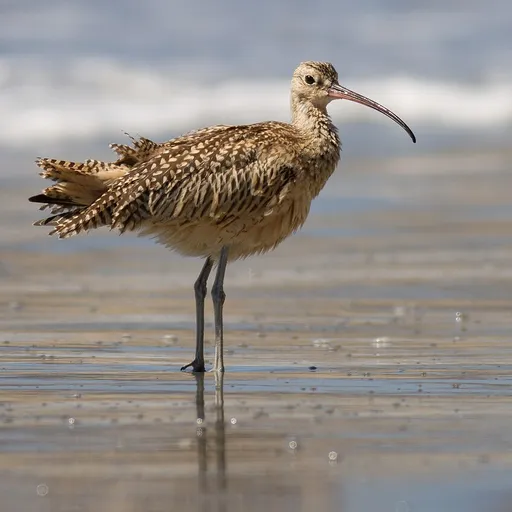
Long-billed Curlew
Numenius americanus
Least Concern
Overview
The long-billed curlew (Numenius americanus) is a large North American shorebird belonging to the family Scolopacidae. Also known as the sicklebird or candlestick bird, it breeds in central and western North America before migrating southward and coastward for the winter.
Identification
- A large sandpiper measuring 50–65 cm in length with a disproportionately long, downward-curving bill that can reach 21.9 cm.
- Features a small head, long neck, light cinnamon underparts, and a brown-streaked crown.
- Exhibits reversed sexual dimorphism, with females being larger and possessing a significantly longer bill than males.
Habitat
This species breeds in the grasslands of west-central North America, subsequently migrating southward and coastward for the winter. Although it was formerly a plentiful wintering bird on the East Coast of the United States, this population has drastically declined to a small 'ghost' group of fewer than a hundred individuals.
Diet
Long-billed curlews often feed in flocks by using their long bills to probe mud or other substrates for food. Their usual diet consists of crabs and various small invertebrates, though they also consume grasshoppers, beetles, and other insects, occasionally taking the eggs of other birds.
Did you know?
The common name 'candlestick bird' led to the naming of Candlestick Point in San Francisco and, by extension, Candlestick Park stadium, although the local flocks that inspired the name were practically extinct by the 1910s.
Sources
- Wikipedia · CC BY-SA 4.0
- Wikidata · CC0 1.0