
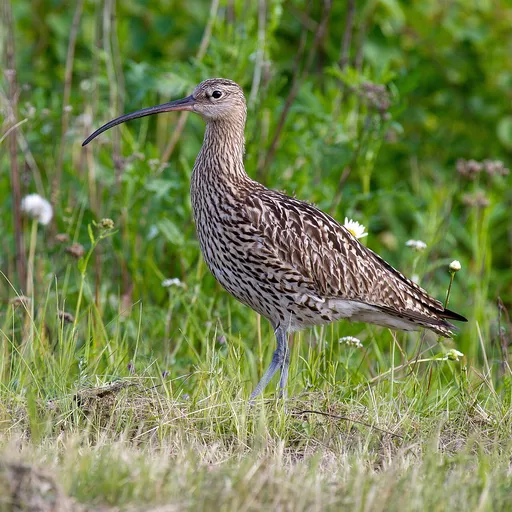
Eurasian Curlew
Numenius arquata
Near Threatened
Listen
XC987706 · wilmet sebastien · Arrondissement de Verdun (near Champneuville), Meuse, Grand Est, France · CC0 1.0
Overview
The Eurasian curlew (Numenius arquata) is a very large wading bird and one of the most widespread curlews, breeding across temperate Europe and Asia. Known as the 'whaup' in Scots, it is currently classified as Near Threatened due to rapid population declines, particularly in the United Kingdom and Ireland.
Identification
- The largest wading bird in its range, measuring 50–60 cm in length with a wingspan of 89–106 cm.
- Primarily greyish brown plumage with white back markings, greyish-blue legs, and a very long, curved bill.
- Produces a loud, familiar call described as 'curloo-oo'.
- Feet are long and form a conspicuous point that extends beyond the tail tip, distinguishing it from similar species like bar-tailed godwits.
Habitat
This migratory species breeds across temperate Europe and Asia, wintering in Africa, southern Europe, and southern Asia. It remains year-round in milder climates such as Ireland and the United Kingdom. Habitat loss from marsh drainage, moorland reclamation, and afforestation has led to local population decreases, although converting forest to grassland has caused increases in parts of Scandinavia.
Diet
The Eurasian curlew feeds by probing soft mud for small invertebrates. It also picks up small crabs and earthworms from the surface when the opportunity arises.
Did you know?
Curlews tend to nest close to common kestrel nests because, although kestrels also prey on curlew eggs, they offer protection against other predators such as corvids.
Sources
- Wikipedia · CC BY-SA 4.0
- Wikidata · CC0 1.0