
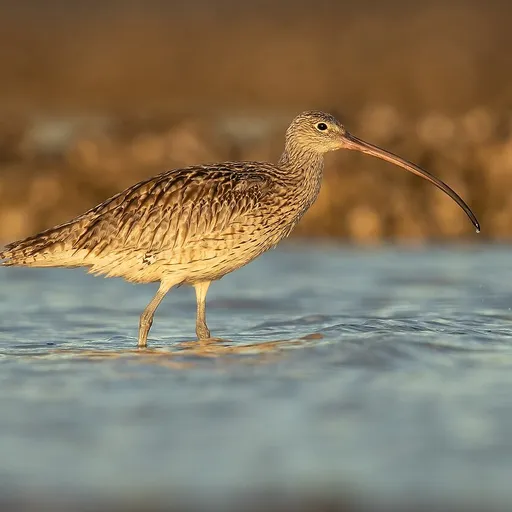
Far Eastern Curlew
Numenius madagascariensis
Endangered
Overview
The Far Eastern curlew (Numenius madagascariensis) is a large wader and the largest of its kind, comparable in size to the long-billed curlew but slightly larger. It is currently classified as Endangered on the IUCN Red List due to population declines linked to habitat loss.
Identification
- Plumage is mostly brown, featuring a plain, unpatterned brown underwing and a distinctive brown rump that separates it from the Eurasian curlew.
- Extremely large size, ranging from 60–66 cm in length and 110 cm across the wings, making it likely the world's largest sandpiper.
- Possesses an extremely long, decurved bill measuring 12.8–20.1 cm in length, rivaling that of the long-billed curlew.
- Vocalisation consists of a sharp, clear whistle described as 'cuuue-reee', often repeated.
Habitat
Breeding occurs in northeastern Asia, including Siberia, Kamchatka, and Mongolia, where the bird favours marshy and swampy wetlands and lakeshores. Non-breeding populations primarily reside in coastal Australia, with some wintering in Indonesia, Thailand, the Philippines, New Zealand, southern China, and Taiwan, utilising estuaries, beaches, and salt marshes. Migration routes commonly involve stopovers on the mudflats of the Yellow Sea and the coasts of Japan.
Diet
The species uses its long bill to probe for invertebrates in the mud, consuming beetles, flies, and amphipods on breeding grounds, berries during migration, and marine invertebrates such as crabs, small molluscs, crustaceans, and polychaetes in the non-breeding season. While it may feed in solitude, it generally congregates in large flocks to migrate or roost.
Did you know?
The species' scientific name refers to Madagascar due to a historical error by zoologist Mathurin Jacques Brisson, yet the bird has never been recorded on that island; its type locality was actually Makassar on Sulawesi, Indonesia.
Sources
- Wikipedia · CC BY-SA 4.0
- Wikidata · CC0 1.0