
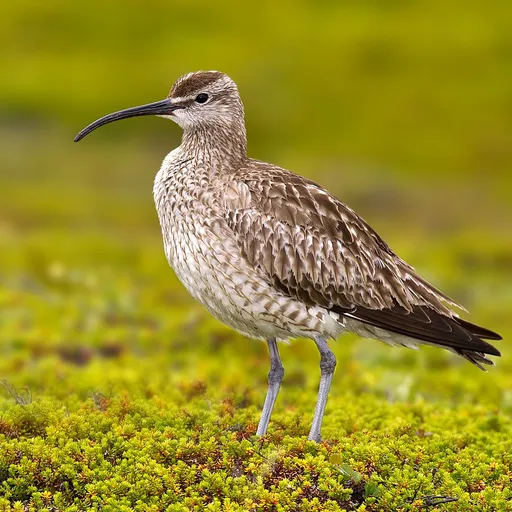
Eurasian Whimbrel
Numenius phaeopus
Least Concern
Listen
XC707066 · Sonothèque ADVL · Genêts, Manche, Normandie, France · CC0 1.0
Overview
The Eurasian whimbrel (Numenius phaeopus) is a wader in the family Scolopacidae and one of the most widespread of the curlews. It breeds across much of the subarctic Palearctic region and Europe, with a range extending as far south as Scotland. This species was split from the Hudsonian whimbrel in 2019, although some authorities still consider them conspecific.
Identification
- Size: A fairly large wader, measuring 37–47 cm in length with a wingspan of 75–90 cm.
- Plumage: Mainly greyish brown with a white back and rump in some subspecies (N. p. phaeopus and N. p. alboaxillaris).
- Bill: Long and curved, characterised by a distinct kink rather than a smooth curve.
- Call: Typically a rippling whistle, prolonged into a trill during song.
Habitat
This species breeds across the subarctic Palearctic and Europe, including specific sites in Scotland such as Shetland, Orkney, and the Outer Hebrides. It is a migratory bird that winters on coasts in Africa, South Asia, and Australasia, and is fairly gregarious outside the breeding season. In Iceland, it prefers lowland plains, grasslands, and wetlands in flat, wet areas with low vegetation.
Diet
The bird feeds by probing soft mud for small invertebrates and picking small crabs and similar prey off the surface. Berries become an important part of its diet before migration, and it has also been observed taking insects, specifically blue tiger butterflies.
Did you know?
During the nesting phase, the mother remains motionless until a threat draws too close, then flies off a short distance and walks around making noises to lure the threat away. Additionally, the English name 'whimbrel' is imitative of the bird's call.
Sources
- Wikipedia · CC BY-SA 4.0
- Wikidata · CC0 1.0