
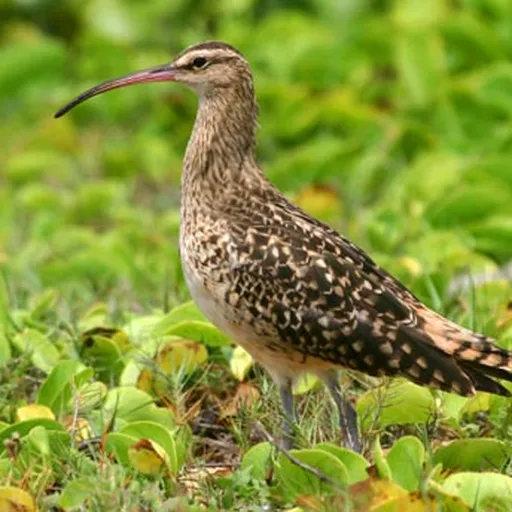
Bristle-thighed Curlew
Numenius tahitiensis
Near Threatened
Overview
The bristle-thighed curlew (Numenius tahitiensis) is a medium-sized shorebird that breeds in Alaska and winters on tropical Pacific islands. It is currently classified as Near Threatened by the IUCN Red List due to concerns over habitat encroachment and introduced predators in its wintering grounds.
Identification
- Measures 40–44 cm in length with an 84 cm wingspan, with females averaging larger than males.
- Possesses a long, decurved bill and distinctive bristled feathers at the base of the legs.
- Plumage is spotted brown on the upper body with a light belly and a rust-coloured or buffy tail.
- Distinguished from similar whimbrels by larger buff spots, an unmarked light belly, barely marked flanks, and a pale buffy-orange rump.
Habitat
The species nests on the lower Yukon River and Seward Peninsula in Alaska, preferring low-lying tundra near the shoreline. Its winter habitat encompasses tropical Oceania, including Micronesia, Fiji, Tuvalu, Tonga, the Hawaiian Islands, Samoa, French Polynesia, and Tongareva (Penrhyn Atoll).
Diet
These birds feed on a wide variety of vegetation such as flowers and berries, as well as insects, sea life, and other bird's eggs. They are unique among shorebirds for using tool use, breaking open eggs with rocks.
Did you know?
The bristle-thighed curlew is capable of non-stop flights exceeding 6,000 km, including an initial 4,000 km leg from Alaska to Laysan. It is also the only shorebird known to exhibit tool use, utilizing rocks to break open other birds' eggs.
Sources
- Wikipedia · CC BY-SA 4.0
- Wikidata · CC0 1.0