
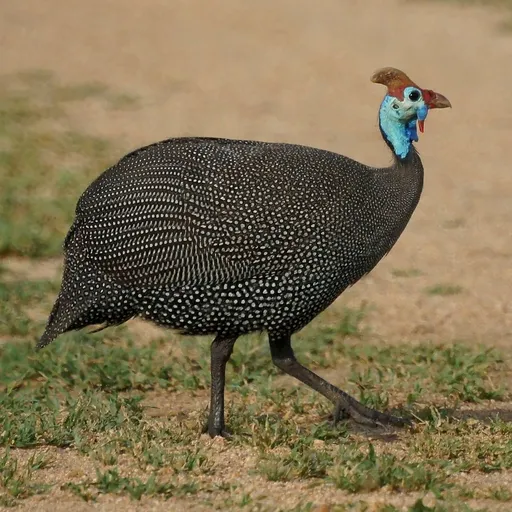
Helmeted Guineafowl
Numida meleagris
Least Concern
Listen
XC1149015 · Kileo Jumah · Ngorongoro Conservation Area (crater floor), Arusha, Tanzania · CC0 1.0
Overview
The helmeted guineafowl, Numida meleagris, is the most well-known member of the guinea fowl family and the only species in the genus Numida. Native to Africa south of the Sahara, it has also been widely introduced as a domesticated species across the Americas, Europe, and Australia.
Identification
- A large, round-bodied bird measuring 53 to 58 cm in length and weighing approximately 1.3 kg, with a relatively small head.
- Body plumage is grey-black speckled with white, contrasting with a bare head adorned with a dull yellow or reddish bony knob and skin in hues of red, blue, or black.
- Features short, rounded wings and a short tail, with strong claws used for scratching the ground.
- Produces loud, harsh calls when disturbed and makes a short-lived, explosive flight followed by gliding.
Habitat
This species breeds in warm, fairly dry, and open habitats characterised by scattered shrubs and trees, such as savannas or farmland. Its natural range is primarily Africa south of the Sahara, though feral populations now exist in many other continents.
Diet
Helmeted guineafowl forage on the ground using strong claws to scratch loose soil for a variety of animal and plant foods. During the non-breeding season, they consume corns, tubers, and seeds, while in the breeding season, invertebrates such as beetles can make up more than 80% of their diet.
Did you know?
Guineafowl are particularly effective at consuming massive quantities of ticks, which helps reduce the spread of Lyme disease. Their domesticated offspring produce eggs with such thick shells that they are reduced to fragments as the chicks, known as keets, hatch.
Sources
- Wikipedia · CC BY-SA 4.0
- Wikidata · CC0 1.0