
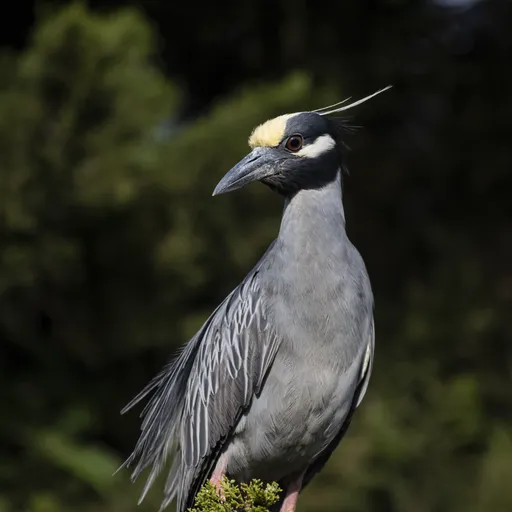
Yellow-crowned Night Heron
Nyctanassa violacea
Least Concern
Overview
The yellow-crowned night heron (Nyctanassa violacea) is a stocky wading bird native exclusively to the Americas. As a member of the heron family, it is distinguished by its nocturnal habits and close dependency on the presence of crustaceans for both food and breeding cues.
Identification
- Plumage: Smooth grey-blue body and back with black scaled wings; head is black and glossy with white cheeks and a pale yellow crown, creating a horizontal striped pattern.
- Bill: Large, heavy, thick, and black, deeply set under dark orange or red eyes.
- Legs: Long and yellow, turning coral, pink, or red during courtship.
- Flight: Long, slow, purposeful wing beats with legs extended straight below the tail, visible unlike the black-crowned night heron.
Habitat
Found in shallow water environments such as marshes, wooded swamps, lakeshores, mangroves, and cliff-bound coasts across the Americas. The species tolerates fresh, brackish, and saltwater and often inhabits areas that experience regular flooding. It is notably unbothered by human presence and can nest in wooded neighborhoods, even on rooftops and driveways.
Diet
The primary diet consists of crustaceans such as crabs and crayfish, supplemented by insects, fish, worms, amphibians, molluscs, and occasionally small vertebrates. Foraging occurs day or night but is preferred at night for feeding young, employing tactics such as visual stalking, standing guard at burrow entrances with back to the sun, or sneaking with the body bent and head retracted.
Did you know?
The yellow-crowned night heron serves as a reservoir host for the eastern equine encephalomyelitis virus, acting as an amplifier for the disease by carrying it over large geographical distances during migration to infect horses and humans.
Sources
- Wikipedia · CC BY-SA 4.0
- Wikidata · CC0 1.0