
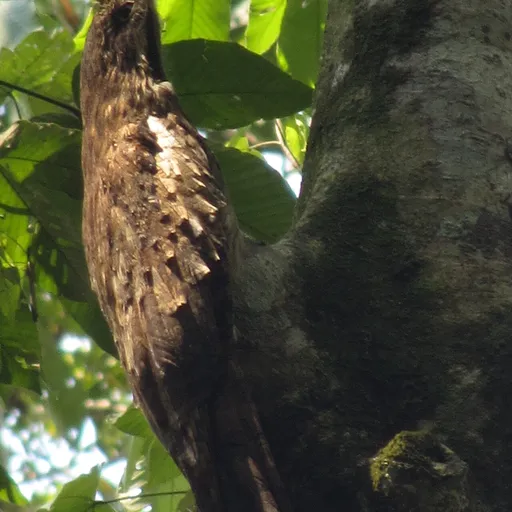
Long-tailed Potoo
Nyctibius aethereus
Least Concern
Overview
The long-tailed potoo (Nyctibius aethereus) is a nocturnal bird found in lowland tropical evergreen forests across mainland South America, excluding Chile and Uruguay. It is classified as Least Concern on the IUCN Red List, although its population is believed to be decreasing.
Identification
- Size of 42 to 58 cm with a weight of 280 to 447 g.
- Upperparts are tawny brown with buff spots, speckles, and blackish brown streaks; the tail is graduated and brown with tawny buff barring.
- The face is mostly tawny with a buffish moustache, while the breast and flanks feature brown plumage with buff speckles and bold spots.
- Song consists of a soft, undulating waa-OO-uh or ra-OOH, often accompanied by a distinctive series of owl-like hoots or woof notes.
Habitat
Inhabits the interiors of lowland tropical evergreen forests, typically occupying the understory to the subcanopy in humid to very wet environments. The nominate subspecies is found in far northeastern Argentina, southeastern Paraguay, and southeastern Brazil, while N. a. chocoensis is restricted to the Chocó Department of western Colombia. The most widely distributed subspecies, N. a. longicaudatus, ranges across Amazonia from Ecuador and Peru to the Guianas, as well as far northern Bolivia and much of western Brazil.
Diet
Nocturnal forager that sallys for flying insects in short flights from a perch, often appearing clumsy and oversized in its movements. While its diet has not been fully detailed, it is known to include termites, moths, and beetles.
Did you know?
During the day, this bird roosts on dead stubs or branches up to 20 m above the ground; if approached, it stretches its body vertically and freezes to avoid detection. It does not build a conventional nest, instead laying its single egg on top of a stump or on a branch in a depression or bend.
Sources
- Wikipedia · CC BY-SA 4.0
- Wikidata · CC0 1.0