
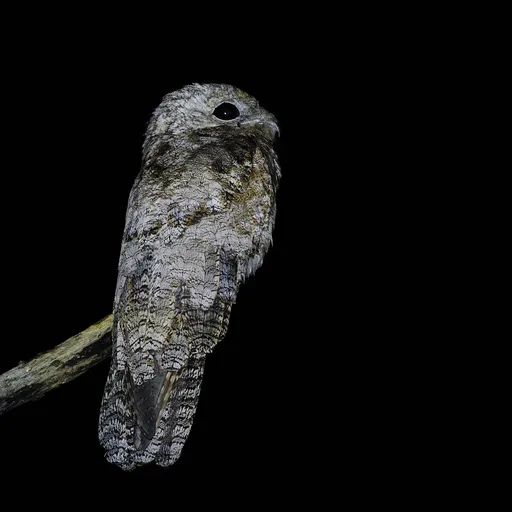
Great Potoo
Nyctibius grandis
Least Concern
Listen
XC1163000 · Alfonso Auerbach · Tela, Tela, Atlántida Department, Honduras · CC0 1.0
Overview
The great potoo (Nyctibius grandis) is the largest of the potoo species, characterised by its nocturnal habits and wide distribution across Central and South America. It is a shy, solitary bird that relies on exceptional camouflage to remain hidden during the day.
Identification
- Large body with a disproportionately large head, large dark brown eyes, and a short but broad beak.
- Plumage is a mix of white, gray, black, and burgundy, featuring white bars laterally across the elongated tail.
- Emits a distinctive moaning growl that echoes through the night.
- Can be located at night by the reflection of light from its eyes as it sits vertically on a trunk or post.
Habitat
The species ranges from southern Mexico through Central America to southeastern Brazil and Bolivia, preferring humid to semi-humid dense lowland forests, forest edges, and clearings. It may also inhabit foothills up to 1,500 m elevation, second-growth areas, and open woodlands, though it always requires trees for its camouflaged perches.
Diet
This nocturnal predator feeds primarily on large flying insects such as beetles, katydids, and Orthoptera, occasionally taking bats and birds. It forages by hawking from high perches, darts out to capture prey that flies by, and then returns to its previous position.
Did you know?
In rural areas of Brazil, local people believe the bird's feathers possess powers to provide chastity and ward off seduction, leading to the collection of body parts for ceremonies despite the bird offering little meat.
Sources
- Wikipedia · CC BY-SA 4.0
- Wikidata · CC0 1.0