
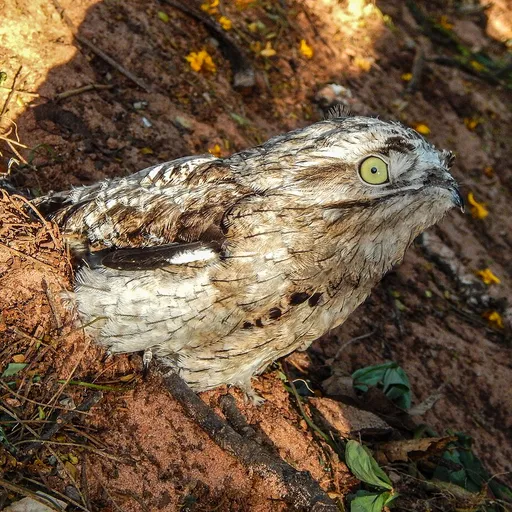
Common Potoo
Nyctibius griseus
Least Concern
Listen
XC251264 · Niels Krabbe · Napo: km 11.6 Narupa-Loreto road, Ecuador · CC BY-SA 4.0
Overview
The common potoo (Nyctibius griseus), also known as the kakuy or urutaú, is a nocturnal bird related to nightjars and frogmouths. It is one of seven species within the genus Nyctibius and is classified as Least Concern on the IUCN Red List, despite a declining population likely due to habitat destruction.
Identification
- 34–38 cm long with mottled red-brown, white, black, and grey cryptic plumage that provides camouflage on branches.
- Notable for large eyes that appear as giant black dots with a small yellow ring, or as giant yellow irises with small pupils depending on voluntary constriction.
- Features an unusually wide mouth with a tooth in the upper mandible.
- Produces a haunting, melancholic song described as 'BO-OU, BO-ou, bo-ou' dropping in pitch and volume; makes a squeaky crow-like sound when seized.
Habitat
A resident breeder in open woodlands and savannah, ranging from eastern Nicaragua and Costa Rica through Panama, west of the Andes in Venezuela, Colombia, and Ecuador, and north and central South America east of the Andes. It avoids cooler montane regions above 1,900 m and arid areas, though it is occasionally found in dry plains and gallery forests.
Diet
This nocturnal insectivore hunts from a perch, using its wide mouth to capture insects such as flies, moths, ants, termites, grasshoppers, and crickets. It possesses a unique tooth in its upper mandible to assist in foraging but swallows its prey whole.
Did you know?
The common potoo has two or three slits in its eyelids that allow it to see even when the eyelids are closed, and the upper and lower eyelids can be moved independently to adjust its field of vision.
Sources
- Wikipedia · CC BY-SA 4.0
- Wikidata · CC0 1.0