
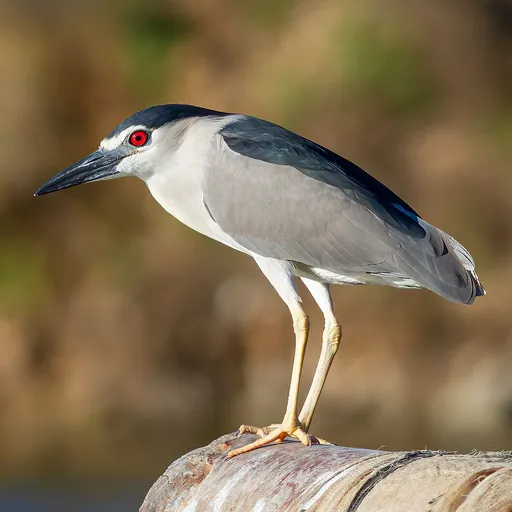
Black-crowned Night Heron
Nycticorax nycticorax
Least Concern
Listen
XC1016771 · Philippe_Grange · Arrondissement de la Roche-sur-Yon (near La Roche-sur-Yon), Vendée, Pays de la Loire, France · CC0 1.0
Overview
The black-crowned night heron, or Nycticorax nycticorax, is a medium-sized heron found across large parts of the world, including Africa, Asia, Europe, and both North and South America. It is classified as Least Concern on the IUCN Red List and is notably replaced in Australasia by the closely related Nankeen night heron.
Identification
- Adults possess a black crown and back, with white or grey underparts, red eyes, and short yellow legs.
- The body is relatively stocky with shorter bills, legs, and necks compared to egrets, often adopting a hunched posture when resting.
- One to eight long, slender white plumes extend from the back of the head, which are erected during greeting and courtship displays.
- Immature birds feature dull grey-brown plumage with pale "teardrop" spots, orange eyes, and duller yellowish-green legs.
Habitat
Breeding habitat consists of fresh and salt-water wetlands throughout much of the world. In northern parts of its range, the bird is migratory, whereas it is otherwise resident, even in colder regions such as Patagonia. In urban environments like San Francisco, they are known for their resilience and have established permanent colonies.
Diet
These birds primarily consume small fish, leeches, earthworms, mussels, squid, crustaceans, frogs, amphibians, aquatic and terrestrial insects, lizards, snakes, small mammals, and even plant material or refuse. They stand still at the water's edge to ambush prey, mainly at night, early morning, or evening. They are among the seven heron species observed to engage in bait fishing, using objects to lure or distract fish within striking range.
Did you know?
The species is named in many languages through onomatopoeia resembling its call, such as "quark" in the Falkland Islands, "hoactli" in Nahuatl, and "quak" in Dutch. This call is also the origin of the word used by ancient authors for a "bird of ill omen".
Sources
- Wikipedia · CC BY-SA 4.0
- Wikidata · CC0 1.0