
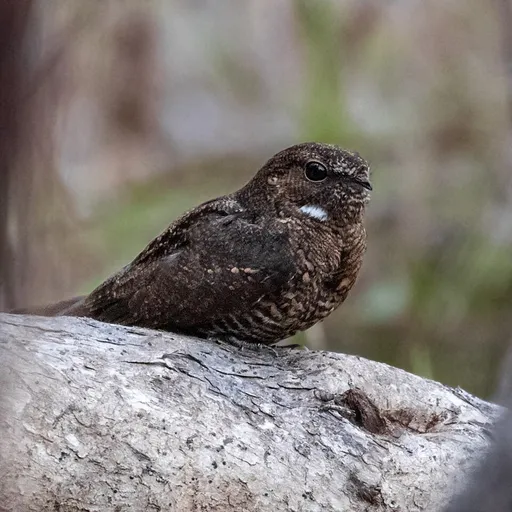
Band-tailed Nighthawk
Nyctiprogne leucopyga
Least Concern
Overview
The band-tailed nighthawk is a small, nocturnal nightjar found throughout northern and central South America. It is a fairly common species with a large geographic range, currently listed as Least Concern on the IUCN Red List.
Identification
- A small bird with cryptically patterned brown plumage that blends with tree bark and leaves.
- Features a very wide, short, black bill hooked at the tip, with dark brown irises and pinkish-grey feet.
- Distinguished by white patches on the sides of the throat and a white band across the three outermost tail feathers.
- Lacks the elongated rictal bristles found in many other nightjar species, and its wings are long with pointed tips.
Habitat
This species inhabits subtropical and tropical areas near water sources such as rivers, streams, marshes, and lakes. It occupies lowland forests, savannahs, grasslands, and swamps at elevations below 200 to 300 m. Its range extends from northern Venezuela and eastern Colombia through the Guianas and Brazil, reaching as far south as northern Bolivia and eastern Paraguay.
Diet
The band-tailed nighthawk is an insectivore that feeds primarily on aerial arthropods, including beetles, ants, true bugs, and flying termites. It forages by hawking in continuous flight, using rapid, shallow wingbeats and gliding to stay aloft. Feeding mainly occurs at dusk and just before dawn, when flying insects are abundant.
Did you know?
The band-tailed nighthawk lacks the elongated rictal bristles common to many other nightjar species. Its territorial call is described as a 'gole-kwoik-kwak' sound that is repeated steadily at a low volume and similar in pitch to a frog's ribbit.
Sources
- Wikipedia · CC BY-SA 4.0
- Wikidata · CC0 1.0