
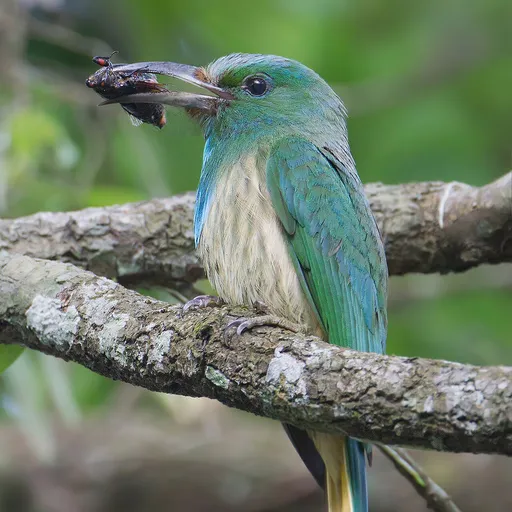
Blue-bearded Bee-eater
Nyctyornis athertoni
Least Concern
Overview
The blue-bearded bee-eater (Nyctyornis athertoni) is the largest species in the bee-eater family, found across much of the Indian subcontinent and parts of Southeast Asia. It inhabits forest clearings in medium elevations and is characterised by its elongated throat feathers, which give it a bearded appearance.
Identification
- Size: 31 to 35 cm in length, weighing 70 to 93 g, making it the largest bee-eater.
- Plumage: Grass green body with a turquoise forehead, face, and chin; yellowish to olive belly with green or blue streaks.
- Head: Elongated blue throat feathers that are often fluffed to create a beard-like effect.
- Call: Loud but infrequent cackling, hornbill-like calls, dry 'Kit-tik' series, or hollow nasal 'kyao' notes.
Habitat
This species is found in thin to fairly thick forests with clearings at medium altitudes, generally below 2000 m. It is distributed mainly in the Malayan region and western peninsular India, occurring in the hill regions of the Satpuras, Western and Eastern Ghats, Nilgiris, Chota Nagpur, and Sub-Himalayan forests. The population is very patchily distributed and often found singly or in small groups of up to three birds.
Diet
The bird feeds mainly on bees, exploiting the defensive behaviour of giant honey bee colonies by provoking the release of guard bees, which it catches in mid-air. Although it primarily forages using aerial sallies, it occasionally gleans insects from bark and may associate with mixed-species foraging flocks.
Did you know?
The species is named after Lieutenant John Atherton, who reported that the bird was found in the thickest jungles feeding at night with noisy 'curr, curr' calls. Although primarily diurnal, historical accounts note this unusual foraging time and secretive behaviour.
Sources
- Wikipedia · CC BY-SA 4.0
- Wikidata · CC0 1.0