
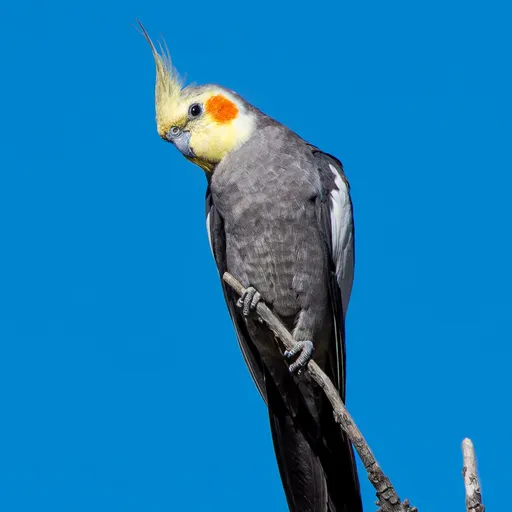
Cockatiel
Nymphicus hollandicus
Least Concern
Overview
The cockatiel (Nymphicus hollandicus), also known as the weero or quarrion, is the smallest member of the cockatoo family. It is the sole member of the genus Nymphicus and is native to Australia. Listed as Least Concern by the IUCN, it is one of the most popular companion parrots worldwide.
Identification
- Body length ranges from 30 to 33 cm, making it the smallest of the cockatoos, with long tail feathers comprising roughly half its total length.
- Wild-type plumage is primarily grey with white flashes on the outer wing edges; males have yellow faces and bright orange cheek patches, while females have grey faces and muted orange cheeks.
- The distinctive erectile crest changes position to express emotion, standing vertical when startled or excited, oblique when relaxed, and flattened when angry or defensive.
- Adult males produce louder, more complex vocalisations than females and can learn to mimic speech, melodies, and household sounds.
Habitat
Cockatiels are native to Australia, favouring wetlands, scrublands, and bushlands, typically in arid or semi-arid regions close to water sources. They are found in western New South Wales, Queensland, the Kimberley region, and the northwestern corner of Western Australia, but are absent from the fertile southeast, the deepest Western Australian deserts, and Cape York Peninsula. The species is largely nomadic, moving to follow food and water availability.
Diet
Wild cockatiels typically eat seeds, particularly from Acacia species, as well as wheat, sunflower, and sorghum. They often forage on cultivated crops, which is a source of conflict with farmers. In captivity, they require a nutritionally appropriate diet to prevent chronic malnutrition.
Did you know?
Cockatiels are the only species within the cockatoo family that can reproduce by the end of their first year. Their colour is derived from melanin and psittacofulvins, with grey melanin overriding yellow and orange pigments, which is why male cheeks and crests brighten as melanin decreases with maturity.
Sources
- Wikipedia · CC BY-SA 4.0
- Wikidata · CC0 1.0