
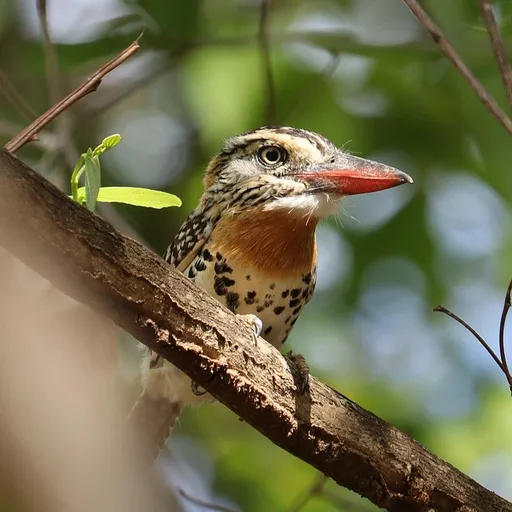
Caatinga Puffbird
Nystalus maculatus
Least Concern
Overview
The Caatinga puffbird (Nystalus maculatus) is a species of bird in the family Bucconidae, found in South America from northeastern Brazil to northwestern Argentina. It is currently classified as Least Concern on the IUCN Red List, with a stable population believed to be common throughout its range.
Identification
- 18 to 19 cm in length, weighing 32 to 38 g, with a mostly red bill, pale yellow eyes, and brownish olive feet.
- Dark brown crown and upperparts marked with bold buffy spangles; pale rufous collar on the hindneck.
- Off-white face with dusky streaks and a buffy supercilium; orange-red throat and upper breast contrasting with white underparts spotted in black.
- Undulating song described as 'tewre-tewtewretewtewre', often performed as a duet or by three birds.
Habitat
Found in lowland and foothill cerrado, caatinga, and campo regions across northeastern and central Brazil, extending south to northwestern Argentina. It inhabits semi-open landscapes, including the interior and edges of deciduous woodland, savanna, palm groves, shrub- and scrublands, and pastures, remaining resident year-round.
Diet
Hunts by sallying from a low perch to capture prey on the ground or in the foliage. Its diet consists mostly of insects, including caterpillars.
Did you know?
The bird was first described in 1648 by Georg Marcgrave using the Tupi name 'Matuitui', with subsequent European classifications not fully separating it from kingfishers until the 19th century.
Sources
- Wikipedia · CC BY-SA 4.0
- Wikidata · CC0 1.0