
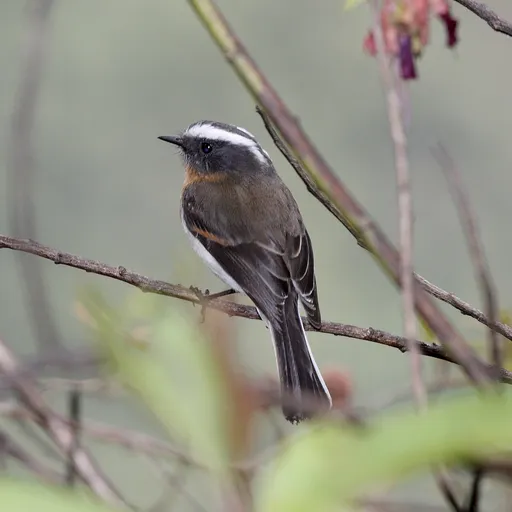
Rufous-breasted Chat-Tyrant
Ochthoeca rufipectoralis
Least Concern
Listen
XC250032 · Niels Krabbe · Azuay: 5.5 km SW Molleturo, Ecuador · CC BY-SA 4.0
Overview
The rufous-breasted chat-tyrant (Ochthoeca rufipectoralis) is a small passerine bird belonging to the tyrant flycatcher family. This species is primarily found in the Andes across South America and is currently assessed as Least Concern on the IUCN Red List.
Identification
- 12.5 to 14 cm in length with a weight of approximately 13 g, featuring a short, thin black bill and black legs.
- Plumage consists of sooty brown upperparts, a white supercilium, and a dark rufous-orange lower throat and breast contrasting with a white belly.
- Day song varies by subspecies, ranging from high buzzy phrases like 'tsi'jiot tzee' to abrupt 'ch-brrr' calls, while the dawn song is generally 'tirip, wee-eeuww'.
- Calls are typically a low, buzzy chattered phrase such as 'bzzter' or 'bzz'tee'.
Habitat
Found across the Andes of Bolivia, Colombia, Ecuador, Peru, and Venezuela, the species primarily inhabits the edges of montane forest, cloudforest, and Polylepis woodlands in the temperate zone. It also occurs in scrubbier and stunted forest near the tree line, particularly in Venezuela. Its elevation range varies by country, generally spanning from 2,300 to 4,100 m, though it is rare at the highest altitudes.
Diet
The rufous-breasted chat-tyrant feeds on insects, usually foraging singly or in pairs, and frequently joining mixed-species feeding flocks. It perches upright in open or semi-open spots between the mid-level and subcanopy, capturing prey with sallies to hover-glean from foliage or take them in mid-air.
Did you know?
The breeding season spans from January to September in Colombia and includes October and November in Peru, but details regarding clutch size, incubation periods, and parental care remain completely unknown.
Sources
- Wikipedia · CC BY-SA 4.0
- Wikidata · CC0 1.0