
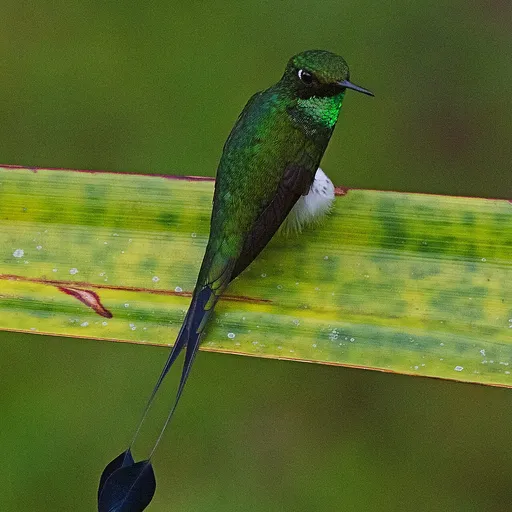
White-booted Racket-tail
Ocreatus underwoodii
Least Concern
Overview
The white-booted racket-tail, Ocreatus underwoodii, is a species of hummingbird in the brilliants tribe. It is classified as Least Concern by the IUCN and is considered a very common species with a stable population.
Identification
- Males feature elongated outer tail feathers with bare shafts and long terminal oval flags that are straight and slightly overlapping.
- Both sexes possess greenish upperparts without a glittering forehead and distinct white leg puffs.
- Males measure 11 to 15 cm in length, while females are 7.6 to 9 cm, with both sexes weighing between 2.5 and 3.2 g.
- Vocalizations include a diagnostic, descending, thin sweet trill described as 'ti-tlee-ee-ee', along with single 'tsit' and 'trrt' notes.
Habitat
This species inhabits the temperate and subtropical Andes of Colombia, Ecuador, and Venezuela, favouring the edges of humid to wet forests as well as the interior and open secondary forests. It is most numerous at elevations between 1,600 and 2,200 m, though its range extends from 600 m to 4,000 m. The species makes seasonal elevational movements after breeding.
Diet
The white-booted racket-tail forages between 6 and 18 m above the ground, often with several birds feeding close together. It feeds on nectar from plants such as Palicourea, Clusia, Inga, and Cavendishia, and captures small insects by hawking from a perch.
Did you know?
The species exhibits pronounced sexual dimorphism, with only the males possessing the elongated outer tail feathers that give the group its name. Females differ from males not just in tail structure but also in the specific pattern of green spots on their white throats and bellies.
Sources
- Wikipedia · CC BY-SA 4.0
- Wikidata · CC0 1.0