
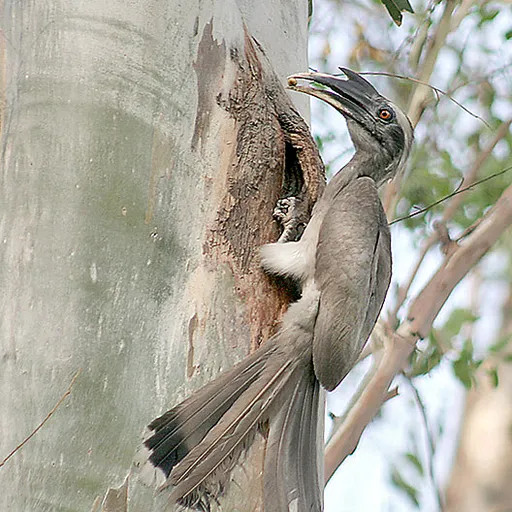
Indian Grey Hornbill
Ocyceros birostris
Least Concern
Overview
The Indian grey hornbill (Ocyceros birostris) is a common, medium-sized hornbill found on the Indian subcontinent. It is an arboreal species typically sighted in pairs, though it is also frequently found in urban areas with large avenue trees.
Identification
- Size: Approximately 61 cm in length.
- Plumage: Greyish brown upperparts with a light grey or dull white belly, dark brown flight feathers with whitish tips, and a tail with a white tip and dark subterminal band.
- Bill and Casque: Black or dark grey horn with a short, pointed casque; the male has a larger casque on a dark bill with yellowish culmen and lower mandible, while the female has a more yellowish bill with black on the basal half.
- Markings: Red iris, slight pale supercilium, and darker ear coverts.
- Voice: A squealing call similar to that of a black kite.
Habitat
The species inhabits the plains up to 610 m, ranging from the foothills of the Himalayas southwards, bounded by the Indus system to the west and the Ganges Delta to the east. It is found in cities with old avenue trees and rarely descends to the ground except to pick up fallen fruits or mud pellets.
Diet
The bird feeds on fruits, molluscs, scorpions, insects, small birds, and reptiles, often foraging in trees such as Streblus asper and Ficus species. It consumes toxic fruits like Thevetia peruviana, which are harmful to many other vertebrates.
Did you know?
During nesting, the female seals herself inside the tree hollow using excreta and mud pellets supplied by the male, leaving only a small vertical slit for feeding while she moults and incubates.
Sources
- Wikipedia · CC BY-SA 4.0
- Wikidata · CC0 1.0