
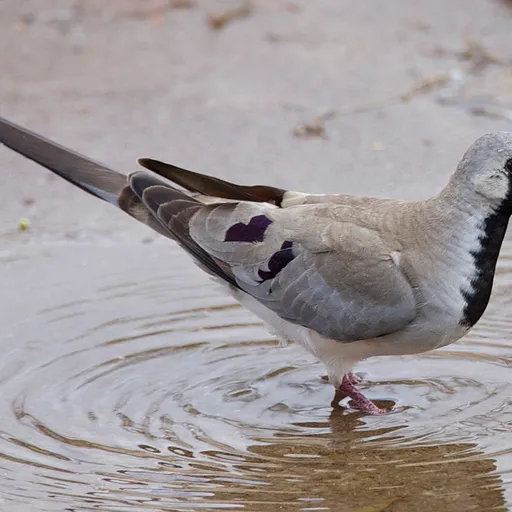
Namaqua Dove
Oena capensis
Least Concern
Overview
The Namaqua dove (Oena capensis) is a very small species of pigeon and the only member of its genus. It is a widespread resident breeding bird across Sub-Saharan Africa, Madagascar, and parts of the Arabian Peninsula.
Identification
- A tiny bird, typically 22 cm long with a wingspan of 28–33 cm, often compared to a budgerigar in size and shape due to its very long, black, tapered tail.
- Plumage is mostly grey with a white belly and chestnut primary feathers visible in flight.
- Adult males feature a yellow and red beak and a distinct black face, throat, and breast, while females lack the black markings and have a red-based grey bill.
- The song is described as a quiet, short, double hoo with a higher second note (kuh-whooo) that is frequently repeated.
Habitat
Found in near-desert environments with acacia trees and bushes, this species ranges widely across Sub-Saharan Africa, Madagascar, the Arabian Peninsula, and parts of Israel and Jordan. It is also known to wander into South Asian countries, including Pakistan and India.
Diet
Primarily terrestrial, the Namaqua dove forages on open ground and roadsides for minute seeds from grasses, sedges, and weeds. It is not gregarious, usually encountered singly or in pairs, but may form larger groups at waterholes.
Did you know?
Despite being a resident of Africa and the Middle East, the species is prone to wandering out of its original range and has been recorded in South Asian countries like Pakistan and India.
Sources
- Wikipedia · CC BY-SA 4.0
- Wikidata · CC0 1.0