
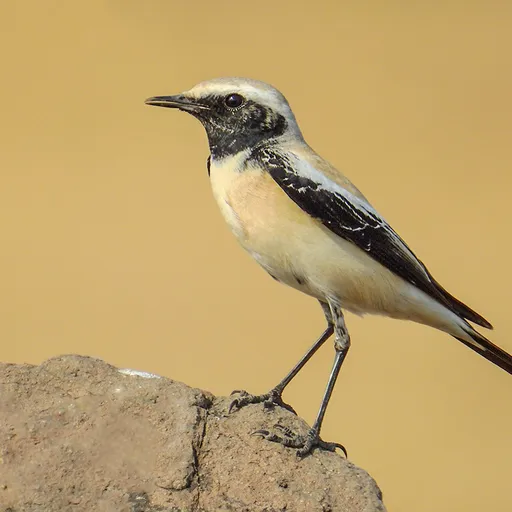
Desert Wheatear
Oenanthe deserti
Least Concern
Listen
XC615083 · ALESSANDRO MOTTA · Castel Volturno, Provincia di Caserta, Campania, Italy · CC BY-SA 4.0
Overview
The desert wheatear (Oenanthe deserti) is a small passerine bird classified as an Old World flycatcher in the family Muscicapidae. This migratory, insectivorous species is characterised by its extensive breeding range across North Africa and Asia and is currently listed as Least Concern on the IUCN Red List.
Identification
- Size and structure: Approximately 14.5 to 15 cm in length, with a weight between 15 and 34 grams, and black beak, legs and feet.
- Male plumage: Buff upperparts, white underparts with a buff tinge on the breast, and a black face, throat and shoulders contrasted by a distinct white superciliary stripe.
- Female plumage: Greyer above and buffier below than the male, lacking the black on the throat, with pale buff lores, chin and throat.
- Tail and eyes: In both sexes, the entire tail is black to the level of the upper tail-coverts, and the irises are dark brown.
Habitat
The species inhabits barren open countryside, including steppes, deserts, semi-arid plains, saltpans and dried-up river beds, reaching altitudes of up to 3,500 metres. Its breeding range extends across the Sahara and northern Arabian Peninsula, as well as the semi-deserts of Central Asia, with wintering grounds in Pakistan and northeast Africa.
Diet
The desert wheatear forages by perching on bushes, tussocks or other eminences to dart to the ground and pounce on prey, though it can also hover to catch insects in the air. Its diet primarily consists of insects such as ants, beetles, caterpillars and flies, as well as the larvae of various invertebrates including ant-lions, and occasionally seeds.
Did you know?
When encountering a large prey insect that it cannot easily manage, the bird sometimes displays in front of the insect by fluttering its wings. Additionally, the common name 'wheatear' is a 16th-century linguistic corruption of 'white' and 'arse', referring to the prominent white rump found in many species, rather than any connection to grain.
Sources
- Wikipedia · CC BY-SA 4.0
- Wikidata · CC0 1.0