
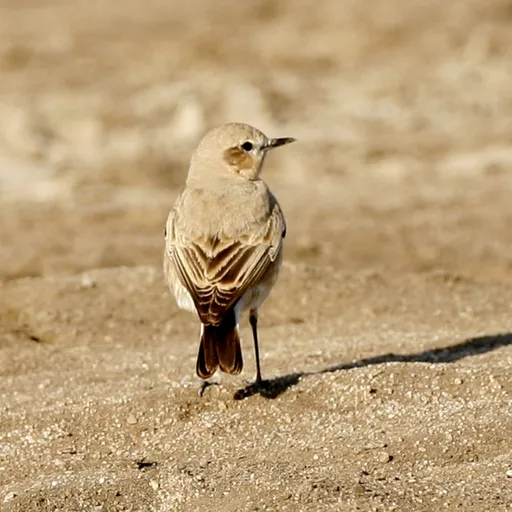
Isabelline Wheatear
Oenanthe isabellina
Least Concern
Overview
The isabelline wheatear (Oenanthe isabellina) is a small passerine bird, currently classified within the Old World flycatcher family Muscicapidae. It is a migratory insectivore that breeds across southern Russia and Central Asia, wintering in Africa and northwestern India. The species is listed as Least Concern by the IUCN Red List.
Identification
- Upperparts are pale sandy brown with an isabelline tinge, while the rump and upper tail-coverts are white.
- Measuring 15–16.5 cm in length, it is larger, more upright, and tawner than the northern wheatear, with white axillaries and underwing coverts.
- Features a prominent over-eye streak of creamy white, pale brown ear-coverts, and black beak, legs, and feet.
- Song is described as lark-like, starting with a croaking noise followed by whistles and mimicry of other birds.
Habitat
Breeding grounds include open country, barren tracts, arid regions, steppes, high plateaux, and lower hill slopes across the eastern Palearctic. In winter, it occupies similar semi-arid habitats with sparse scrub and cultivated borders, showing a preference for sandy ground. It is a very rare vagrant to western Europe, having occurred in Greece, Cyprus, Algeria, and Tunisia.
Diet
Primarily insectivorous, feeding on ants, grasshoppers, moths, flies, mites, spiders, and insect larvae, occasionally consuming seeds. It forages mostly along the ground by probing the soil with its beak, though it sometimes flutters into the air to catch prey.
Did you know?
The name 'isabelline' references Isabella I of Castile, who is said to have promised not to change her undergarments until Spain was freed from the Moors, describing a parchment-like greyish-yellow colour. Additionally, the term 'wheatear' is a 16th-century linguistic corruption of 'white arse', referring to the species' prominent white rump.
Sources
- Wikipedia · CC BY-SA 4.0
- Wikidata · CC0 1.0