
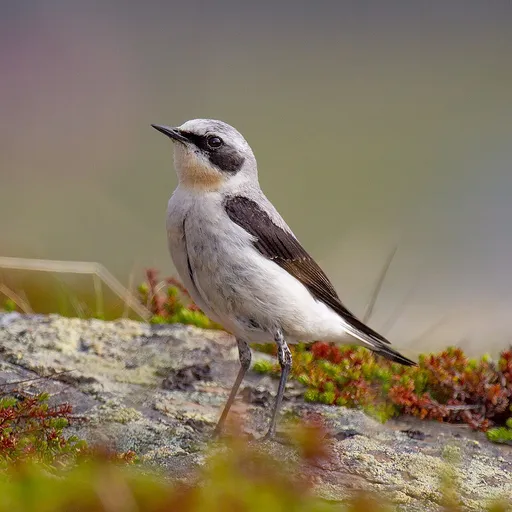
Northern Wheatear
Oenanthe oenanthe
Least Concern
Listen
XC815486 · Sonothèque ADVL · Courtils, Manche, Normandie, France · CC0 1.0
Overview
The northern wheatear (Oenanthe oenanthe) is a small passerine bird in the Old World flycatcher family and the most widespread member of the wheatear genus in Europe and Asia. It is a migratory insectivore that breeds in open stony country across the Palearctic, North and Central Asia, and parts of North America, with all individuals wintering in Africa.
Identification
- Length of 14.5–16 cm with a wingspan of 26–32 cm, making it larger than a European robin.
- Distinctive white rump and tail featuring a black inverted T-pattern at the end.
- Summer males have grey upperparts, a buff throat, black wings, and a black face mask, while females are pale brown above and buff below with darker brown wings.
- Males produce a whistling, crackly song and a typical chat 'chack' call.
Habitat
The species breeds in open stony country across Europe, the Palearctic, and extends into northeastern Canada, Greenland, Alaska, and northwestern Canada. Nests are typically situated in rock crevices, rabbit burrows, or man-made cavities such as walls and pipes.
Diet
The northern wheatear is an insectivorous species that feeds primarily on insects.
Did you know?
The English name 'wheatear' is an altered form of 'white-arse', referring to the bird's prominent white rump, and has no connection to wheat. During the 18th and 19th centuries, the bird was considered a delicacy in England and known as 'the English ortolan'.
Sources
- Wikipedia · CC BY-SA 4.0
- Wikidata · CC0 1.0