
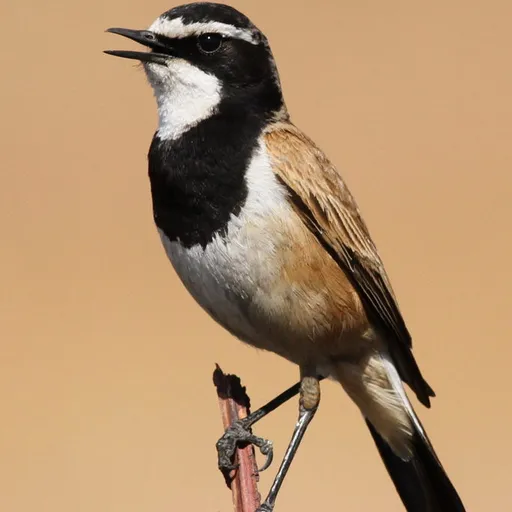
Capped Wheatear
Oenanthe pileata
Least Concern
Overview
The capped wheatear (Oenanthe pileata) is a small, insectivorous passerine bird widely distributed across southern Africa. It is currently classified in the Old World flycatcher family, Muscicapidae, although it was formerly placed in the thrush family.
Identification
- 17–18 cm in length with a weight of approximately 32 g, featuring a pointed black bill and black legs.
- Distinctive plumage includes a black cap, cheeks, and breast band contrasting with a white throat and eye stripe, while underparts are white with buff flanks.
- A striking tail pattern displays an inverted black 'T' on the white rump, formed by the base and centre of the feathers.
- Juveniles possess a brown cap and cheeks with a weak, diffuse breast band, distinguishing them from the larger, rare migrant northern wheatear.
Habitat
This species occupies open dry sandy and stony habitats, as well as short grassland dotted with bushes and termite mounds. Its range extends from Kenya and Angola southwards to the Cape, where it remains largely non-migratory but may undertake seasonal movements.
Diet
Feeding primarily on insects, especially ants, this solitary bird forages by perching on mounds, hopping over short grass, or flying low over the ground.
Did you know?
The bird constructs its nest from straw, grass, and leaves within a hole in the ground or a termite mound, though it is known to utilise man-made drainage pipes when available.
Sources
- Wikipedia · CC BY-SA 4.0
- Wikidata · CC0 1.0