
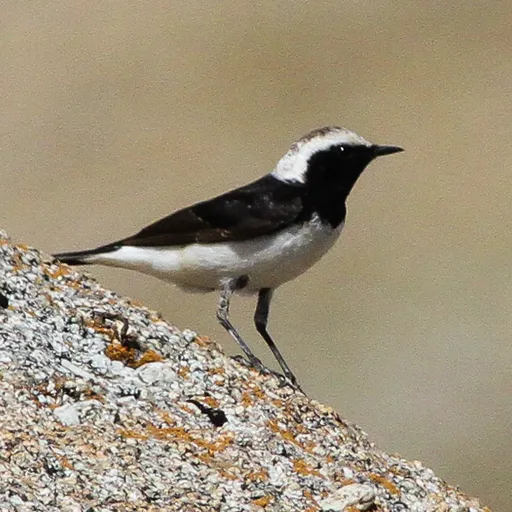
Pied Wheatear
Oenanthe pleschanka
Least Concern
Listen
XC929263 · Jochem Verweij · Ögiy, O'giinuur, Arkhangai, Mongolia · CC BY-SA 4.0
Overview
The pied wheatear (Oenanthe pleschanka) is a small insectivorous passerine bird classified as an Old World flycatcher. This migratory central Asiatic species ranges from the extreme southeast of Europe to China and is rated as Least Concern by BirdLife International.
Identification
- The male is boldly marked in white and black, featuring a brown-tinged white crown, a black face and throat, and a creamy-white rump.
- Females are browner with sandy buff on the head and show less white on the rump than northern wheatears.
- The tail feathers display an inverted black 'T' pattern on a white background, resembling the western black-eared wheatear.
- A 14-centimetre bird with a black bill and legs; the male's song is low-pitched, musical and imitative, often performed from a high perch.
Habitat
Native to southeast Europe and western Asia, the breeding range extends from Romania and Bulgaria to Siberia, Altai, and Mongolia. The bird occupies rough open country, stony slopes, and steppes with scant vegetation, reaching altitudes up to 3,000 metres. It migrates to northeast Africa and has occasionally appeared as a vagrant in western Europe.
Diet
Primarily insectivorous, the pied wheatear feeds on small invertebrates including ants, grasshoppers, beetles, and moths, along with spiders, mites, and seeds. It forages by perching on bushes or rocks, swooping briefly to the ground to pick up prey, and then returning to the perch.
Did you know?
The common name 'wheatear' is not derived from wheat or an ear of grain, but is a 16th-century linguistic corruption of 'white' and 'arse', referring to the prominent white rump characteristic of most species in the group.
Sources
- Wikipedia · CC BY-SA 4.0
- Wikidata · CC0 1.0