
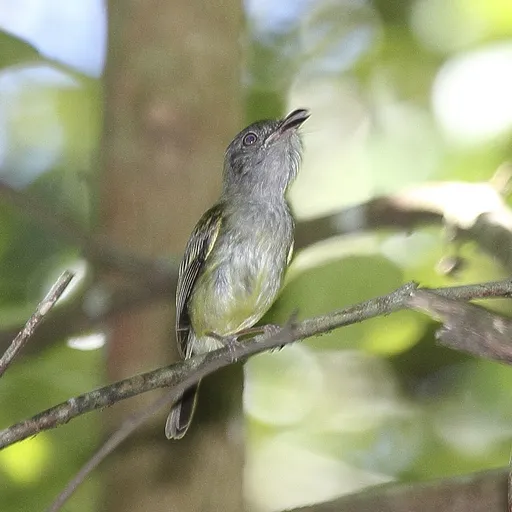
Northern Bentbill
Oncostoma cinereigulare
Least Concern
Overview
The northern bentbill (Oncostoma cinereigulare) is a small bird belonging to the family Tyrannidae, commonly known as tyrant flycatchers. It is a year-round resident that inhabits humid forests and scrublands across Central America and southern Mexico.
Identification
- Length of 9.5 to 10.5 cm with a weight of 4.5 to 7 g, featuring a distinctive fairly thick downcurved bill.
- Mostly pale gray head with an olive back, rump, and uppertail coverts; dusky wings display lemon yellow edges on flight feathers forming two wing bars.
- Throat and breast are pale gray with olive streaks, while the belly is pale lemon-yellow with an olive wash on the flanks.
- Pale yellow iris, a gray bill with a pinkish base, and pinkish legs and feet; sexes share the same plumage.
Habitat
Found in the interior and edges of humid lowland evergreen, semi-deciduous, and deciduous forests, as well as secondary woodlands and partially open scrublands in the tropical zone, favouring thickets and dense undergrowth. Its range extends from southern Mexico through Central America to western Panama, at elevations from sea level to 1,500 m.
Diet
Feeds primarily on arthropods and occasionally on small berries, foraging in dense vegetation near the ground but as high as 6 m above it. It typically forages singly or in pairs, taking prey by using short upward sallies from a perch to grab it from leaves before flying to a new location.
Did you know?
The breeding biology is heavily female-led, with the female alone building the nest, incubating the clutch of two eggs, and apparently provisioning the nestlings exclusively.
Sources
- Wikipedia · CC BY-SA 4.0
- Wikidata · CC0 1.0