
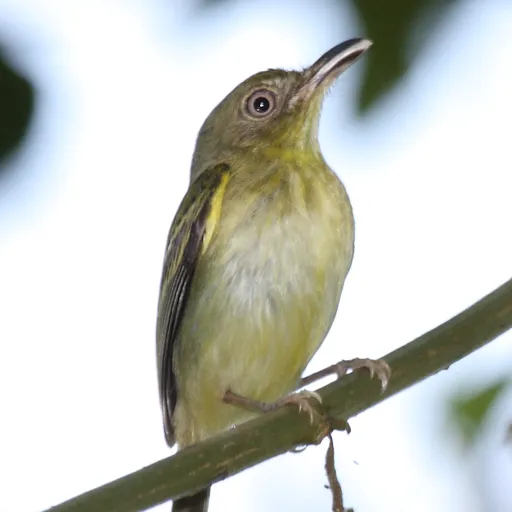
Southern Bentbill
Oncostoma olivaceum
Least Concern
Listen
XC759711 · radrat · Corregimiento de Cristóbal (near Gamboa), Colón, Colón Province, Panama · CC0 1.0
Overview
The southern bentbill (Oncostoma olivaceum) is a species of bird in the family Tyrannidae, the tyrant flycatchers. It is classified as Least Concern by the IUCN, with an estimated population of at least 500,000 mature individuals.
Identification
- Approximately 9 cm long and weighing 6 to 7 g, with a distinctive, fairly thick downcurved gray bill.
- Adults feature an olive head with a whitish area above the lores, and an olive back and rump; wings are dusky with lemon yellow edges and two indistinct wing bars.
- Underparts include a yellowish-white throat and breast with olive streaks, a yellow belly, and olive-yellow flanks.
- The call is described as a guttural insect-like or toad-like trill, 'grrrrrrr', or a soft mechanical 'errreet'.
Habitat
Found in central and eastern Panama and northern Colombia, the species inhabits humid lowland evergreen forest, secondary woodlands, and shrubby clearings in the tropical zone. It prefers thickets and dense undergrowth at elevations ranging from sea level to 1,300 m.
Diet
The southern bentbill feeds primarily on arthropods and occasionally on small berries, typically foraging singly or in pairs within dense vegetation. It catches prey using short upward sallies from a perch, moving from leaves to leaves between foraging spots.
Did you know?
The bird constructs a flask- or pear-shaped nest from plant fibers, often with dangling fibers at the bottom, which is suspended from a thin branch between 1 and 4 m above the ground. The clutch consists of two eggs, which the female is believed to incubate alone for approximately 19 days.
Sources
- Wikipedia · CC BY-SA 4.0
- Wikidata · CC0 1.0