
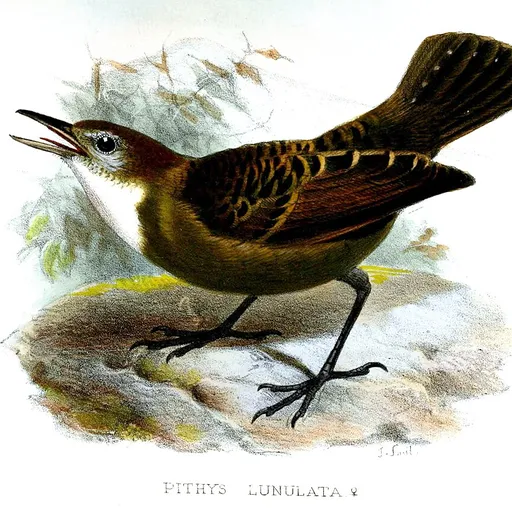
Lunulated Antbird
Oneillornis lunulatus
Least Concern
Listen
XC249163 · Niels Krabbe · Orellana: 'Maxus' road km 37 (27 km SSE Pompeya), Ecuador · CC BY-SA 4.0
Overview
The lunulated antbird (Oneillornis lunulatus) is a species of insectivorous bird belonging to the family Thamnophilidae. It is a non-migratory species found in the forest undergrowth of South America and is currently classified as Least Concern by the IUCN.
Identification
- Adult males are mostly gray with a white supercilium, ear coverts, chin, and throat, and a blackish-gray tail.
- Adult females feature a white supercilium, dark olive-brown lores, and a yellowish olive-brown crown and nape; their backs have blackish edges and light buff tips on the feathers.
- The species measures 13 to 14.5 cm in length and weighs between 22 and 26 g.
- The song is described as a distinct introductory note followed by a rapid, decelerating series of popping notes that transition into rising mellow whistles, roughly sounding like "pipi'pi'pwee-pwee-pwee-peeerr".
Habitat
Found in eastern Ecuador and northern and central Peru, the species primarily inhabits humid várzea evergreen forest and transitional forest between várzea and terra firme. It almost entirely remains in the forest undergrowth, occurring below 300 m in elevation in Ecuador but reaching up to 950 m locally in Peru.
Diet
An obligate ant follower, it feeds on arthropods that flee from foraging army ant swarms, such as Eciton burchelli and the genus Labidus. The bird forages individually, in pairs, or in family groups, typically perching within about 1 m of the ground before sallying or pouncing to the ground after prey.
Did you know?
The species shares its genus, Oneillornis, with the white-throated antbird (O. salvini), although the latter has historically been treated as conspecific. The genus itself was established in 2014 based on molecular phylogenetic studies.
Sources
- Wikipedia · CC BY-SA 4.0
- Wikidata · CC0 1.0