
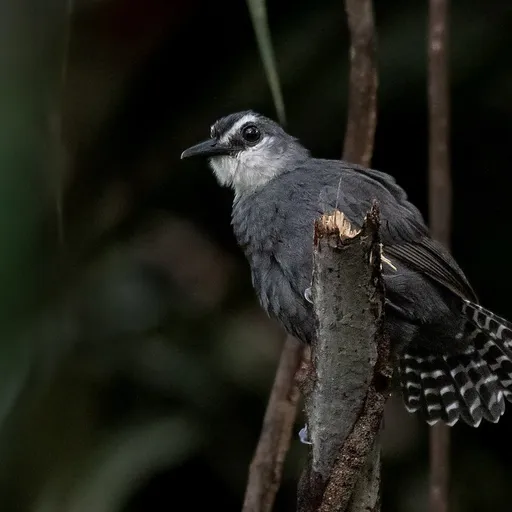
White-throated Antbird
Oneillornis salvini
Least Concern
Overview
The white-throated antbird is a species in the family Thamnophilidae found in the western Amazon Basin. It is an obligate follower of army ant swarms and is currently assessed as Least Concern by the IUCN.
Identification
- Length of 13 to 14.5 cm, with males appearing mostly gray and females displaying rufous and olive-brown plumage.
- Males possess a white supercilium, ear coverts, chin, and throat, while females feature a dark olive-brown crown and rufous nape and throat.
- Song consists of a slow, resounding series of three to four descending, long, upslurred 'weeih' notes or a 'RHEEE?-rheee?' pattern.
- Calls include a puttering, descending rattle and a rich 'tchup'.
Habitat
Inhabits the western Amazon Basin across eastern Peru, southwestern Brazil, and northwestern and central Bolivia. Primarily found in humid terra firme evergreen forest, though it also uses seasonally flooded forest and transition zones. Almost entirely remains in the forest undergrowth at elevations below 450 m in Brazil and up to 800 m in Peru.
Diet
Feeds on a wide variety of arthropods that flee foraging army ant swarms, such as those of Eciton burchelli and the genus Labidus. Typically forages individually, in pairs, or in family groups, perching within about 1 m of the ground and sallying or pouncing to the ground after prey.
Did you know?
The bird is dominant over smaller antbirds but subordinate to larger species of other families, such as woodcreepers, within the mixed flocks it follows.
Sources
- Wikipedia · CC BY-SA 4.0
- Wikidata · CC0 1.0