
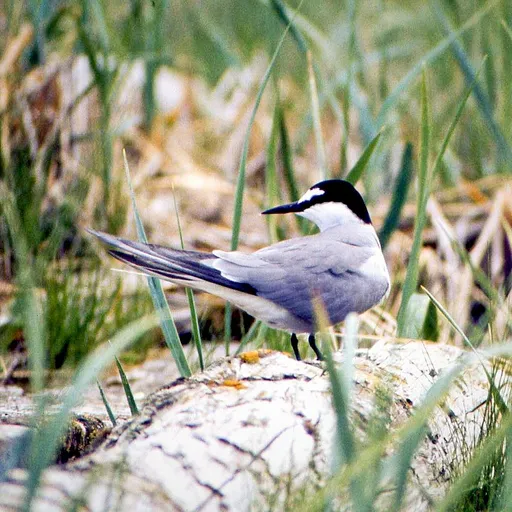
Aleutian Tern
Onychoprion aleuticus
Vulnerable
Overview
The Aleutian tern (Onychoprion aleuticus) is a medium-sized migratory seabird that spends most of the year in the subarctic region, closely resembling the Arctic tern. It is currently classified as a Vulnerable species by the IUCN due to significant population declines across its breeding range.
Identification
- Size and Build: Medium-sized tern measuring 32–39 cm in length with a 75–80 cm wingspan, featuring a short pointed bill and a long, deeply forked tail.
- Plumage: Breeding adults have a distinctive white forehead, black cap, mid-grey mantle, and darker grey underparts; non-breeding adults have a white speckled crown and white underparts.
- Bill and Legs: Both the bill and legs are black, which distinguishes it from the Arctic tern that has bright red appendages during the breeding season.
- Vocalisation: The call includes a choppy "chif-chif-chu-ak" and a prolonged "whee-hee-hee-hee" stressed on the first syllable, which is less harsh than the sustained note of the Arctic tern.
Habitat
Breeding colonies are found along the Pacific coastlines of Alaska and eastern Siberia, utilising partially vegetated sandy beaches, grassy meadows, mossy boglands, and marshes on isolated rocky islands or near river mouths. When not breeding, the species is pelagic, with wintering areas believed to lie off Indonesia, Malaysia, and the South Pacific, having recently been spotted on Australia's eastern coast.
Diet
Aleutian terns primarily feed on small fish, but also consume crustaceans, insects, and zooplankton. They forage by flying low over water and surface-dipping, and occasionally hawk insects over freshwater ponds.
Did you know?
Unlike the fiercely defensive Arctic terns, Aleutian terns are not aggressive in defence of their nests or young and often rely on the aggressiveness of neighbouring Arctic terns to chase potential predators from the colony.
Sources
- Wikipedia · CC BY-SA 4.0
- Wikidata · CC0 1.0