
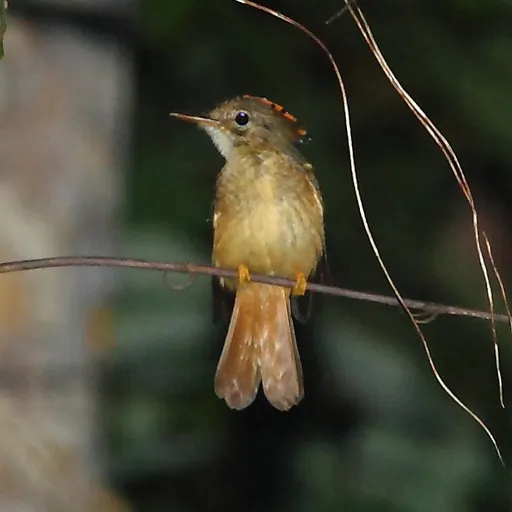
Tropical Royal Flycatcher
Onychorhynchus coronatus
Least Concern
Overview
The tropical royal flycatcher (Onychorhynchus coronatus) is a passerine bird that most taxonomic systems place in the family Onychorhynchidae. It is found in Mexico, south through most of Central America, and in every mainland South American country except Argentina, Chile, Paraguay, and Uruguay.
Identification
- Approximately 12.5 to 18 cm long with an erectile fan-shaped crest that is red with blue tips in males of the nominate subspecies and yellow or orange in females.
- Dark brown upperparts with narrow black and buffy bars on the lower back, and cinnamon-rufous rump and tail that is browner towards the end.
- Whitish throat, warm buff breast with narrow black bars, and plain warm buff belly; adults have a broken buffy eye ring and a faint buffy streak on the cheek.
- Legs and feet are dull yellow or orangish, with a maxilla that is dark brown to blackish and a mandible that is horn to yellowish or orange.
Habitat
The species inhabits humid lowlands, including both primary evergreen and second-growth forests. It is typically found in the lower levels and midstory, often along streams and in seasonally flooded várzea forest. Elevation varies by region, ranging from sea level up to 1,200 m in much of Central America and Colombia, though lower in parts of Costa Rica, Brazil, and Ecuador.
Diet
The tropical royal flycatcher is insectivorous, foraging up to 3 m above the ground in most subspecies, though O. c. occidentalis will feed as high as 15 m. It typically forages singly or in pairs, occasionally joining mixed-species feeding flocks. The bird sallies from a perch to capture prey in mid-air or from foliage and branches, returning to the perch to eat it.
Did you know?
The nest of this species is long and narrow, suspended from a branch or vine, usually above water. Only the female incubates the two-egg clutch and subsequently broods and feeds the nestlings.
Sources
- Wikipedia · CC BY-SA 4.0
- Wikidata · CC0 1.0