
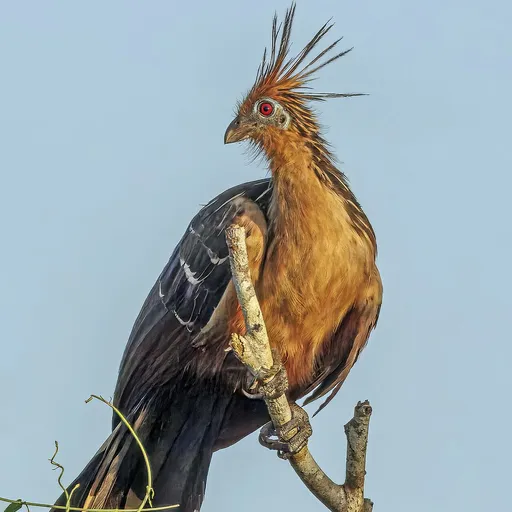
Hoatzin
Opisthocomus hoazin
Least Concern
Listen
XC251282 · Niels Krabbe · Sucumbíos: 'La Selva Jungle Lodge', n bank Río Napo, Ecuador · CC BY-SA 4.0
Overview
The hoatzin (Opisthocomus hoazin) is a tropical bird found in the Amazon and Orinoco Basins of South America. It is the sole surviving species in its family and is notable for possessing a digestive system that ferments plant matter, a trait more commonly associated with herbivorous mammals. As the national bird of Guyana, it is also known locally as the Canje pheasant.
Identification
- Pheasant-sized with a total length of 65 cm, featuring a long neck, small head, and a spiky, rufous crest.
- Unfeathered, blue face with maroon eyes and a sooty-brown tail tipped with a broad whitish or buff band.
- Upper parts are dark with buff-edged wing coverts, while underparts are buff with rich rufous-chestnut flanks visible when the wings are opened.
- Noisy bird that produces a variety of hoarse calls, including groans, croaks, hisses, and grunts, often accompanied by body movements like wing spreading.
Habitat
The hoatzin inhabits swamps, riparian forests, and mangroves within the Amazon and Orinoco Basins in South America. It is believed to remain fairly common in large parts of its range, though its population is likely decreasing due to habitat loss from Amazonian deforestation.
Diet
As a folivore, the hoatzin primarily consumes the leaves of over 50 botanical species, with some intake of flowers and fruits. It forages by clampering around branches, using serrations on its beak to cut leaves into smaller pieces for its unique foregut fermentation system. The species is known to have a disagreeable, manure-like odor due to the bacterial fermentation of its leafy diet.
Did you know?
Hoatzin chicks possess primitive claws on two of their wing digits, allowing them to scramble on branches and climb back to safety after dropping into the water to escape predators. This trait has led to comparisons with the fossil bird Archaeopteryx, though it is likely a secondary adaptation rather than a direct evolutionary link.
Sources
- Wikipedia · CC BY-SA 4.0
- Wikidata · CC0 1.0