
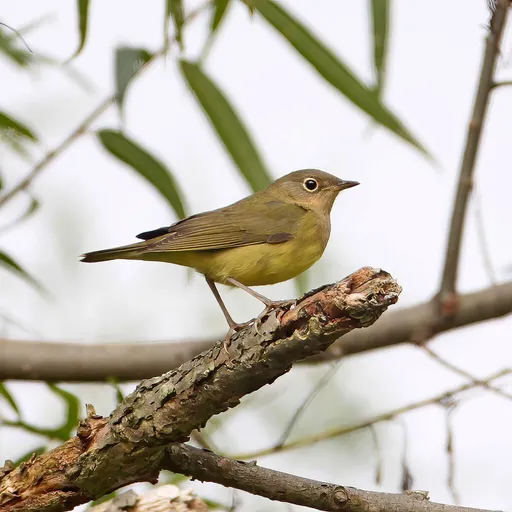
Connecticut Warbler
Oporornis agilis
Least Concern
Overview
The Connecticut warbler (Oporornis agilis) is a small songbird of the New World warbler family, currently classified as Least Concern on the IUCN Red List. It is an elusive species that breeds in central Canada and the Great Lakes region, migrating to the Amazon Basin in South America for the winter.
Identification
- Light yellow underparts with olive upperparts, a light eye-ring, pink legs, a long tail, and a thin pointed bill.
- Males feature a grey hood, whereas females and immatures are browner with a whitish throat.
- Adults measure 13–15 cm in length with a wingspan of 22–23 cm.
- The song is a loud repeated 'cheepa-cheepa', similar in pitch to the Kentucky warbler, and the call is a nasal, raspy 'witch'.
Habitat
Breeding habitat consists of bogs or open deciduous woods near water, particularly those containing poplar, spruce, tamarack, or aspen in central Canada and states bordering the Great Lakes. These habitats are often remote and difficult to access, leading to limited data on the species.
Diet
These birds forage on the ground among dead leaves or hop along branches within dense, low vegetation to find insects and similar small invertebrates. They occasionally supplement their diet with seeds and berries.
Did you know?
Despite its name, the Connecticut warbler only rarely visits Connecticut during migration, having been named by Alexander Wilson who observed the first classified specimen. It undertakes an atypical migration route, passing through the Midwest in spring but moving through the East Coast in larger numbers during the fall.
Sources
- Wikipedia · CC BY-SA 4.0
- Wikidata · CC0 1.0