
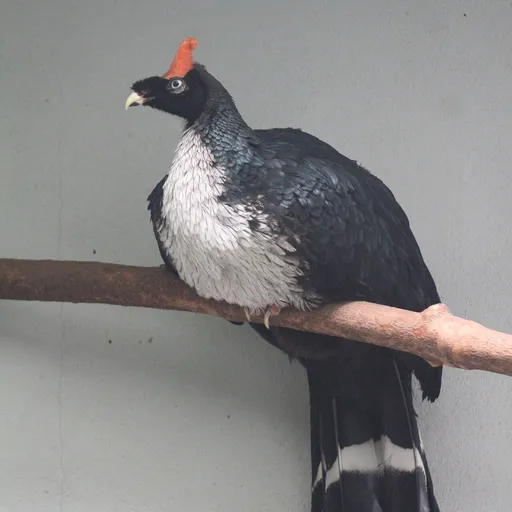
Horned Guan
Oreophasis derbianus
Endangered
Overview
The horned guan is an endangered species in an ancient group of birds within the family Cracidae, related to Australasian megapodes. It is the only survivor of a lineage that has evolved independently for at least 20 million years.
Identification
- 75 to 85 cm long with a small head, long strong legs, and a long broad tail.
- A tall, red, fleshy 'horn' on the forehead, which is taller in males.
- Glossy black head, neck, and upperparts with a bluish sheen; tail is black with a wide white band near the base.
- Whitish throat and breast with black flecks, brown lower belly and flanks, and a yellow bill with red legs.
- Males produce a deep, slow 'mooing' call, while females emit loud, guttural 'guurk' sounds.
Habitat
Found in the southern Mexican states of Chiapas and possibly Oaxaca, as well as southern Guatemala, with unconfirmed reports from Honduras. It inhabits humid subtropical montane evergreen forests, cloud forests, and pine-oak forests characterized by tree ferns, epiphytes, mosses, and vines. Elevation typically ranges between 2,300 and 3,100 m, though locally it occurs from 1,200 m to 3,350 m.
Diet
The species feeds mostly on a wide variety of fruits, with green leaves forming a significant part of its diet, and consumes flowers and possibly insects in small amounts. It forages singly or in small groups at all levels of the forest, including the ground. Many seeds pass intact through its system, suggesting it may be a significant dispersal agent.
Did you know?
The horned guan is monotypic and represents the only survivor of a very ancient lineage of cracids that has been evolving independently from all other living members of its family for up to 40 million years.
Sources
- Wikipedia · CC BY-SA 4.0
- Wikidata · CC0 1.0