
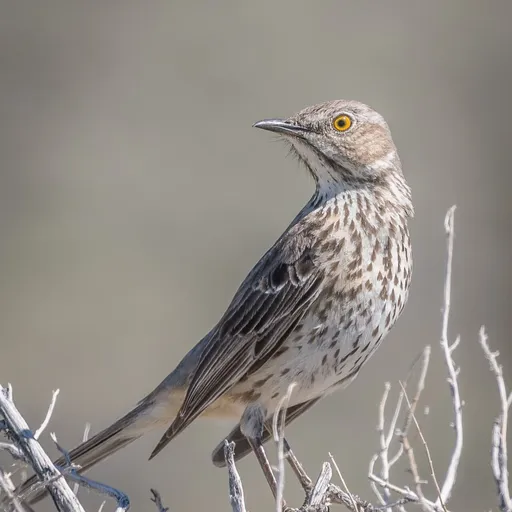
Sage Thrasher
Oreoscoptes montanus
Least Concern
Overview
The sage thrasher (Oreoscoptes montanus) is a medium-sized passerine bird in the family Mimidae and the smallest of the thrashers. It is the only species in the genus Oreoscoptes and is found in the shrubsteppe regions of western North America.
Identification
- Measures 20.0–23.0 cm in length and weighs 39.6–50.3 g, distinguished from similar thrashers by its smaller size, shorter tail, and shorter, less curved bill.
- Adults possess brownish-gray upperparts and white underparts marked with dark streaks, while juveniles have paler upperparts and lightly streaked underparts.
- Features distinctive lemon-yellow to amber eyes.
- Song consists of long sequences of soft, moderately musical syllables without harsh notes, often including imitations of species such as the Western Meadowlark, Brewer's Sparrow, and Horned Lark.
Habitat
The species strongly associates with shrubsteppe habitats dominated by big sagebrush (Artemisia tridentata), which is essential for nesting and protection. Its breeding range extends from the Great Basin to southern British Columbia, with wintering grounds in southern United States and northern Mexico.
Diet
Sage thrashers are opportunistic feeders that primarily forage on the ground for terrestrial insects, including ants, ground beetles, true bugs, grasshoppers, and crickets. They also consume berries and seeds, and have been observed digging in soil to eat cricket egg beds.
Did you know?
Like some relatives, the sage thrasher can recognise and reject eggs of brood-parasitic brown-headed cowbirds, a behaviour supported by their large enough bill to eject the foreign eggs.
Sources
- Wikipedia · CC BY-SA 4.0
- Wikidata · CC0 1.0