
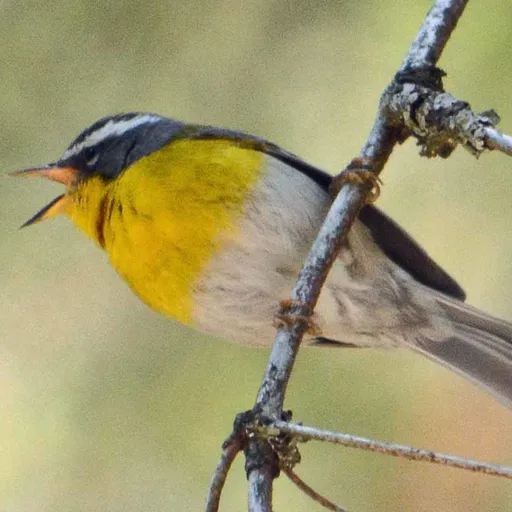
Crescent-chested Warbler
Oreothlypis superciliosa
Least Concern
Overview
The crescent-chested warbler (Oreothlypis superciliosa) is a small New World warbler that is common throughout its montane range from northern Mexico to northern Nicaragua. It shows a distinct affinity for oaks and is occasionally found as a vagrant in parts of the United States.
Identification
- Superficially similar to the northern and tropical parulas, featuring yellow underparts, a grey head, and a greenish back.
- Distinguished by a bold white eyebrow, a marking not found in similar species.
- Adult males display a discrete chestnut crescent on the breast, which is less prominent or sometimes lacking in females and young birds.
Habitat
The species resides in mountainous regions from northern Mexico to northern Nicaragua, with a particular preference for oak habitats. It is largely sedentary, although northern populations may move south or to lower altitudes during winter, and it is a rare vagrant to southern Arizona and western Texas.
Diet
Primarily feeding on insects, these birds occasionally consume fruit and berries in the middle to upper levels of trees. They forage by jumping from twigs and foliage, picking food from the underside of leaves and hanging beneath them in a fashion similar to chickadees to check surfaces for prey.
Did you know?
These monogamous and usually solitary birds become gregarious in winter, joining mixed-species flocks to feed. Additionally, the female performs distraction displays, acting as if she is injured to lure predators away from the nest during the chicks' early development.
Sources
- Wikipedia · CC BY-SA 4.0
- Wikidata · CC0 1.0