
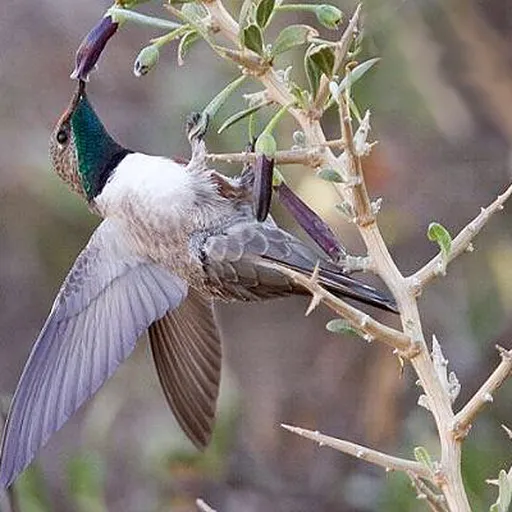
Andean Hillstar
Oreotrochilus estella
Least Concern
Overview
The Andean hillstar (Oreotrochilus estella) is a species of hummingbird belonging to the coquettes tribe. It is assessed as Least Concern by the IUCN and is considered one of the most common birds in the puna grasslands of the high central Andes.
Identification
- Males possess drab brown upperparts, a shiny green gorget bordered by black, and a white breast with a rufous stripe down the belly; females are dull brown above and below with a pale, speckled throat.
- Length ranges from 13 to 15 cm, with adult males weighing approximately 8.8 g and females 8.0 g.
- Features a medium-length, slightly decurved black bill.
- Vocalisations include a repeated short 'tsip' or 'swit', and during chases, a rapid, melodious, passerine-like twittering.
Habitat
Found in Argentina, Bolivia, Chile, and Peru, this species inhabits puna grasslands, particularly areas with rock outcroppings, as well as the edges of Polylepis woodlands and stands of Puya raimondii. It occurs at elevations between 2,400 and 5,000 m, though it is most common between 3,500 and 4,500 m.
Diet
The bird feeds on nectar from flowering shrubs, cacti, and trees, often perching to save energy rather than hovering. It also gleans arthropods from vegetation and occasionally catches them on the wing.
Did you know?
To survive cold nights and winters, the Andean hillstar enters a state of torpor similar to hibernation, using caves and deep crevices to lower its metabolic rate. This shelter likely also protects it from nocturnal predation.
Sources
- Wikipedia · CC BY-SA 4.0
- Wikidata · CC0 1.0