
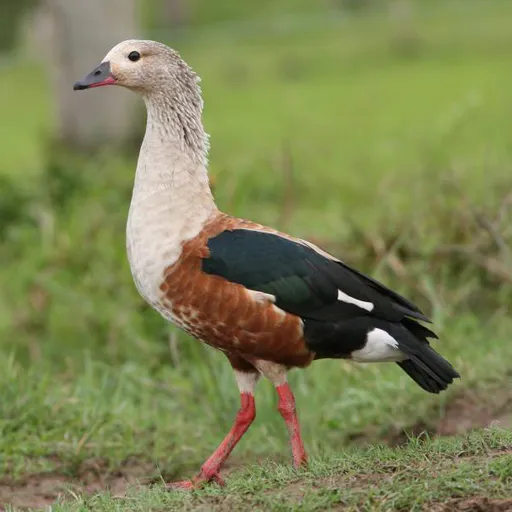
Orinoco Goose
Oressochen jubatus
Overview
The Orinoco goose (Neochen jubata or Oressochen jubatus) is a species of waterfowl found across mainland South America, excluding Chile, French Guiana, Suriname, and Uruguay. It inhabits wet savannas and the edges of large freshwater wetlands, with some populations migrating significantly between breeding and non-breeding sites.
Identification
- Adults are 61 to 76 cm long, with males weighing around 1.8 kg and females around 1.3 kg.
- Males have an off-white head, neck, and breast with buffy streaks on the nape and a gray mantle featuring white scalloping and an orange band across the upper mantle.
- They possess a bill with a black maxilla and a mostly red mandible, along with bright salmon-red legs and feet in males, which are dull orange in females.
- The species is very vocal, with males producing high whistles and guttural honks, and females making loud cackles and low guttural honks.
Habitat
The Orinoco goose inhabits wet savannas and the edges of large freshwater wetlands during the wet season, and in the dry season, it is also found on river beaches and oxbow lakes in the Amazon Basin. Its range extends from Venezuela south through Colombia, eastern Ecuador, eastern Peru, and Bolivia into far northern Argentina and central Brazil, with an isolated population spanning the northern Brazil–Guyana border.
Diet
The Orinoco goose is herbivorous, feeding mainly on the leaves and seed heads of grasses, as well as aquatic algae in stagnant water along rivers and oxbows. It mostly forages during the day in open areas near water but also forages at night, moving between feeding and resting areas at dawn and dusk.
Did you know?
Orinoco geese are sometimes brood parasites, with a female laying eggs in another Orinoco goose's nest; in one study, parasitized nests had a clutch size averaging about 19 eggs compared to seven in unparasitized nests. Migration of these birds may also spread the apicomplexan parasites Toxoplasma gondii and Neospora caninum.