
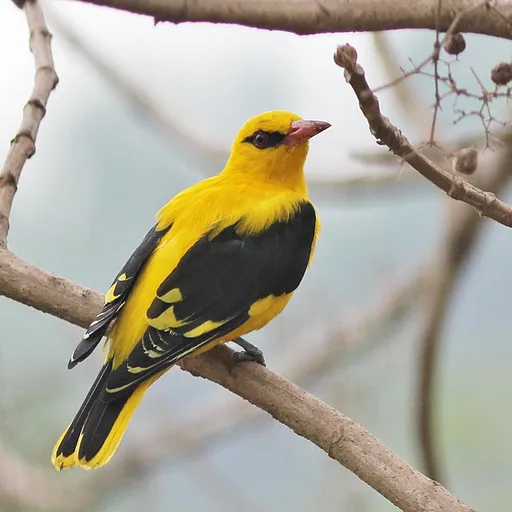
Indian Golden Oriole
Oriolus kundoo
Least Concern
Overview
The Indian golden oriole (Oriolus kundoo) is a species of oriole found across the Indian subcontinent and Central Asia, though it was formerly considered a subspecies of the Eurasian golden oriole. It is classified as Least Concern on the IUCN Red List and was recognised as a distinct species based on morphological differences and molecular phylogenetic studies.
Identification
- Adults can be distinguished from the Eurasian golden oriole by the black eye stripe extending behind the eye.
- The species exhibits more yellow in the tail and a paler shade of red in the iris and bill compared to the European counterpart.
- Males feature a large carpal patch on the wing and wide yellow tips to the secondaries and tertiaries, while females have sharper streaks on the underside.
Habitat
This species inhabits a diverse range of environments, including open deciduous and semi-evergreen forests, woodland, forest edges, mangroves, and open country with scattered trees, as well as human-modified areas such as parks, gardens, orchards, and plantations. Its breeding range extends from Baluchistan and Afghanistan along the Himalayas to Nepal, with northern populations wintering in southern India and Sri Lanka.
Diet
The Indian golden oriole feeds on fruits, nectar, and insects, and is capable of dispersing the seeds of many berry-bearing plants, including the invasive Lantana camara. An individual has also been recorded preying on southern flying lizards.
Did you know?
An individual ringed in Gujarat was recovered in Tajikistan more than nine years later, demonstrating significant long-distance movement despite the species being largely resident in India. The bird is also capable of dipping flight that reaches speeds of about 40 km/h (25 mph).
Sources
- Wikipedia · CC BY-SA 4.0
- Wikidata · CC0 1.0