
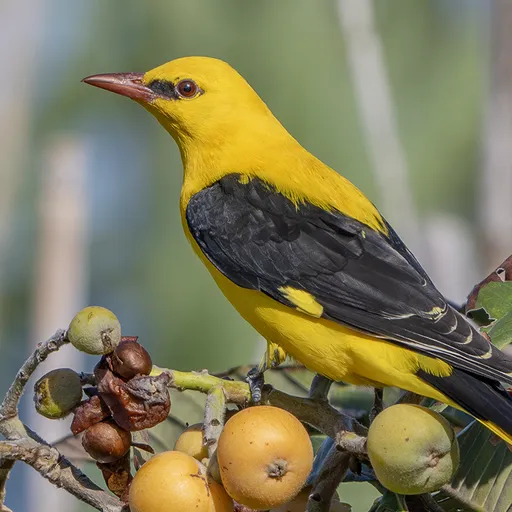
Eurasian Golden Oriole
Oriolus oriolus
Least Concern
Listen
XC730595 · Sonothèque ADVL · Sougéal, Ille-et-Vilaine, Bretagne, France · CC0 1.0
Overview
The Eurasian golden oriole, also known as the common golden oriole, is a passerine bird and the only Old World oriole breeding in Northern Hemisphere temperate regions. It is a summer migrant in Europe and the Palearctic that spends the winter season in central and southern Africa.
Identification
- Measures approximately 24 cm in length with a wingspan of 44–45 cm.
- Males display striking black and yellow plumage, while females are a drabber green.
- In flight, they appear somewhat like a thrush, flying strong and direct with some shallow dips over longer distances.
- The call is a harsh "kweeaahk", but the song is a fluting "weela-wee-ooo" or "or-iii-ole", which is unmistakable once heard.
Habitat
The breeding range spans from western Europe and Scandinavia east to China, with birds generally preferring open broadleaf forests, plantations, copses, riverine forests, orchards, and large gardens in Western Europe. In Eastern Europe, they may inhabit more continuous forests as well as mixed or coniferous forests, while generally avoiding treeless habitats. During winter, they are found in central and southern Africa in semi-arid to humid woodland, tall forests, riverine forest, woodland/savanna mosaic, and savanna.
Diet
They feed on insects and fruit, using their bills to pick insects out of crevices. During the autumn migration via the Eastern Mediterranean, they feed on fruit, a behaviour that often leads to them being considered a pest in that region.
Did you know?
In medieval England, the bird was known as the woodwele, a name derived from its song. Albertus Magnus erroneously stated in about 1250 that the Latin name oriolus was onomatopoeic because of this song.
Sources
- Wikipedia · CC BY-SA 4.0
- Wikidata · CC0 1.0