
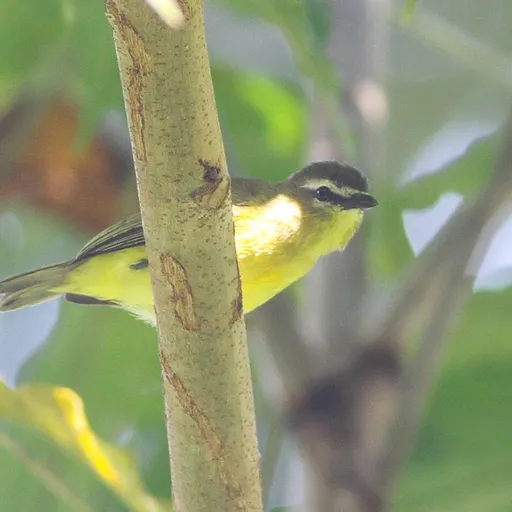
Brown-capped Tyrannulet
Ornithion brunneicapillus
Least Concern
Listen
XC248176 · Niels Krabbe · Esmeraldas: 23 road km NNW Alto Tambo, 2 km N main road, Ecuador · CC BY-SA 4.0
Overview
The brown-capped tyrannulet (Ornithion brunneicapillus) is a small flycatcher belonging to the family Tyrannidae. It is a year-round resident found across Central and South America, currently assessed as a species of Least Concern by the IUCN.
Identification
- Approximately 8 cm long with a pointed bill, brown iris, and dark grey legs.
- Brownish olive to dark brown crown featuring a white forehead, lores, and supercilium on an olive face.
- Dusky olive wings and tail with bright yellow underparts that have faint olive streaks on the breast and flanks.
- Vocalises with a series of 4–6 high metallic or piping whistles, often transcribed as 'pee, pey-pey-pew'.
Habitat
This species inhabits tropical and lower subtropical zones, primarily the interior and edges of humid evergreen forest, mature secondary forest, semi-open woodlands, and coffee plantations. Its range extends from far southern Nicaragua and the Caribbean slope of Costa Rica through Panama, Colombia, and Ecuador, as well as parts of Venezuela. Elevations vary by country, ranging from sea level to 1,300 m.
Diet
The brown-capped tyrannulet feeds almost exclusively on arthropods, typically foraging singly or in pairs within the mid-level to the canopy of the forest. It often joins mixed-species feeding flocks and takes prey by gleaning from leaves, twigs, and stems while perched.
Did you know?
Despite being a tyrant flycatcher, its foraging behaviour is much like that of a warbler or vireo. Its nest is described as an untidy flat saucer made from twigs, leaf petioles, and bark.
Sources
- Wikipedia · CC BY-SA 4.0
- Wikidata · CC0 1.0