
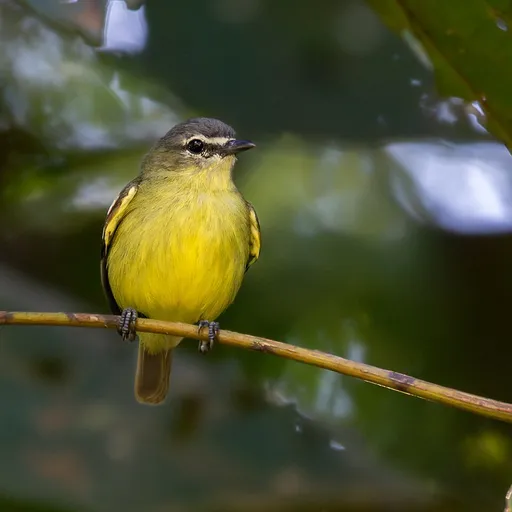
White-lored Tyrannulet
Ornithion inerme
Least Concern
Listen
XC248755 · Niels Krabbe · Sucumbíos: 'La Selva Jungle Lodge', n bank Río Napo, Ecuador · CC BY-SA 4.0
Overview
The white-lored tyrannulet (Ornithion inerme) is a small tyrant flycatcher found across a disjunct distribution in South America. It inhabits tropical lowland evergreen forests, favouring the canopy and forest edges within the Amazon Basin and along parts of the southeastern Brazilian coast.
Identification
- A tiny flycatcher measuring 8 to 9 cm, featuring a rather thick black bill, dark brown irises, and dark gray or black legs.
- Distinctive plumage includes a gray crown and nape, an olive upperbody, and a white line extending from the eye across the forehead contrasting with gray lores on an olive face.
- Underparts are mostly pale yellow with a light olivaceous wash on the breast, while the closed wings display two rows of pale yellow spots on the greater and median coverts.
- Highly vocal and often heard before being seen, its song consists of thin, rising whistles described as 'weet-weet-weet?' or high-pitched, wheezy 'pee, dee-dee-deet' sequences that may end in a metallic accelerating trill when excited.
Habitat
This species resides in tropical lowland evergreen forest, typically between sea level and 1,000 m, though elevational limits vary by country. It has a disjunct range covering almost the entire Amazon Basin, stretching from the Andes of Colombia and Peru east through Venezuela, the Guianas, and northern Brazil, with an additional coastal population in southeastern Brazil. Within its habitat, it favours the canopy but is often more abundant at edges such as watercourses, lakes, and gaps created by fallen trees.
Diet
The white-lored tyrannulet feeds almost exclusively on arthropods, though specific details are lacking. It forages singly or in pairs within the forest canopy and frequently joins mixed-species feeding flocks. Prey is obtained by gleaning from leaves, twigs, and stems while perched or hanging, as well as through short upward flutter flights and brief hovering.
Did you know?
Despite its wide distribution, the breeding biology of the white-lored tyrannulet is almost completely unknown. The only documented data point regarding its breeding season is a single observation in December in Peru.
Sources
- Wikipedia · CC BY-SA 4.0
- Wikidata · CC0 1.0