
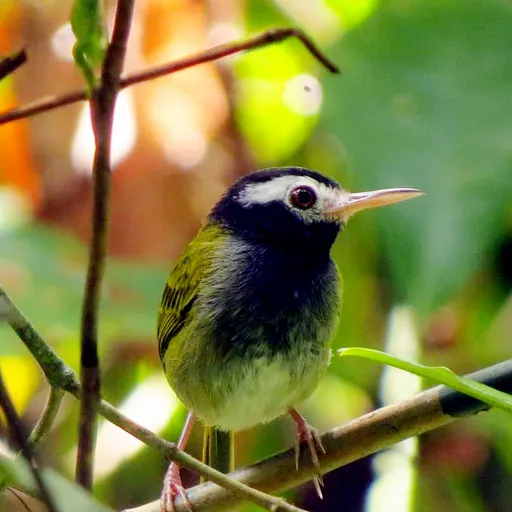
Black-headed Tailorbird
Orthotomus nigriceps
Least Concern
Overview
The black-headed tailorbird, also known as the white-browed tailorbird, is a small songbird in the cisticola family endemic to the southeastern Philippines. It inhabits dense undergrowth in lowland forests on the islands of Mindanao, Dinagat, and Siargao and is classified as Least Concern on the IUCN Red List.
Identification
- Adults feature dull black heads, necks, and chests with a prominent white supercilium, line beneath the eye, and chin patch, contrasting with dull grey underparts and olive-green upperparts.
- Average length is 12 cm with a body mass of 8–14 g; legs are pale pink and the bill is blackish on the upper mandible and whitish on the lower.
- The call consists of lengthy, stuttering trills that slow and flatten out, possessing a more 'metallic ringing quality' than the similar yellow-breasted tailorbird.
Habitat
This non-migratory species is endemic to the islands of Mindanao, Dinagat, and Siargao in the southeastern Philippines, specifically found in dense undergrowth within lowland forests at elevations up to 1,000 m. It appears to avoid habitats affected by human activities, such as agricultural ecosystems.
Diet
The bird feeds on small invertebrates, foraging most commonly in pairs within the undergrowth where it remains elusive and seldom seen in the open.
Did you know?
For seven decades, the species was mistakenly believed to exhibit sexual dimorphism due to differences in throat colour, but a 2022 study confirmed that the variations are actually due to maturity stages, with adults showing a 'black' phenotype, immatures a 'mottled' one, and juveniles a 'grey' one.
Sources
- Wikipedia · CC BY-SA 4.0
- Wikidata · CC0 1.0