
Pheasant Pigeon
Otidiphaps nobilis
Least Concern
Overview
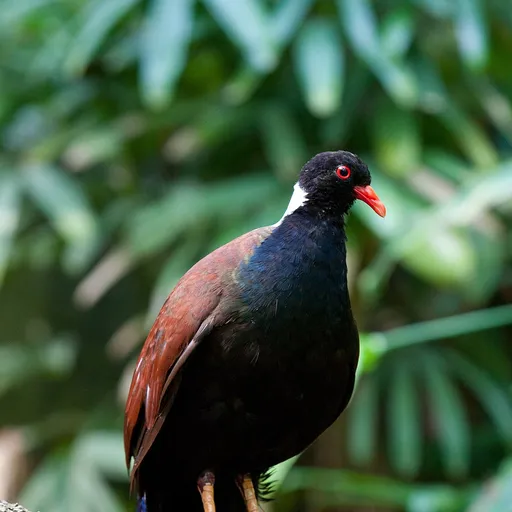
The pheasant pigeon (Otidiphaps nobilis) is a large, terrestrial pigeon that is the only species in the monotypic genus Otidiphaps. It is notable for its adaptation to living on the forest floor, resembling a South East Asian pheasant rather than a typical pigeon.
Identification
- Resembles a pheasant with a laterally compressed tail and short, rounded brown wings.
- Features glossy black heads, undersides, rears, and lower backs, with a nape that is white, green, grey, or black depending on the subspecies.
- Vocalisations include a drilling-like sound, a typical pigeon coo, and a loud 'wu-huwoooooa' call that rises and falls in pitch before trailing off.
Habitat
Found in the primary rainforests of New Guinea and nearby islands, such as the Aru Islands, Batanta, and Waigeo. The species primarily ranges over hilly and lower mountain areas but can also be found in lowland regions.
Diet
Feeds on seeds and fallen fruits on the forest floor. As a highly secretive species that avoids human settlements, detailed foraging behaviour is largely based on observations at zoos.
Did you know?
The black-naped pheasant pigeon was thought to be extinct for 126 years after specimens collected in the 19th century, but was rediscovered in 2022 when captured on a trail camera by Jordan Boersma and colleagues on Fergusson Island.
Sources
- Wikipedia · CC BY-SA 4.0
- Wikidata · CC0 1.0