
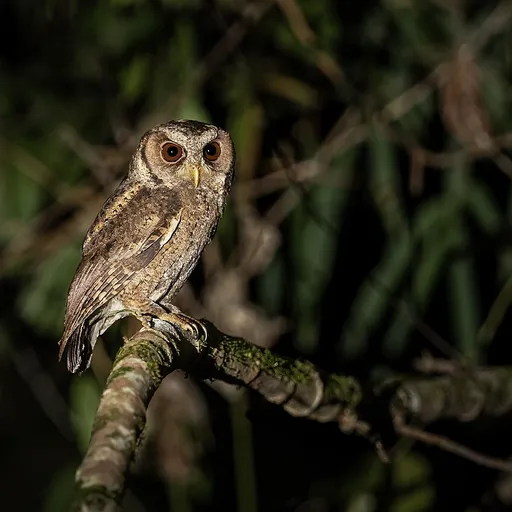
Collared Scops Owl
Otus lettia
Least Concern
Overview
The collared scops owl (Otus lettia) is a small owl that serves as a resident breeder across south Asia, including northern Pakistan, India, Nepal, Bangladesh, the Himalayas east to southern China, and Taiwan. It is partially migratory, with some individuals wintering in India, Sri Lanka, and Malaysia. This species is currently listed as Least Concern on the IUCN Red List.
Identification
- Size: A small owl measuring 23–25 cm, though it is the largest of the scops owls.
- Plumage: Upperparts are grey or brown with faint buff spotting, while underparts are buff with fine darker streaking; a buff neckband is present.
- Facial Features: Possesses small head tufts or ears, with a whitish or buff facial disc and orange or brown eyes.
- Call: Produces a quiet "goog gook" call, which is the primary method for distinguishing it from the similar-looking Indian and Oriental scops owls.
- Flight: Characterised by a deeply undulating flight pattern.
Habitat
This species is a common breeding bird in forests and other well-wooded areas. Its range covers north Asia, stretching from northern Pakistan and India east to southern China and Taiwan, with some populations moving to Sri Lanka and Malaysia for the winter. It is chiefly found in northern India, where it is replaced by the Oriental scops owl further south.
Diet
The collared scops owl feeds mainly on insects. It is nocturnal but can often be located by small birds mobbing it while it roosts in a tree.
Did you know?
Despite being the largest of the scops owls, this species is so visually similar to the smaller Indian and Oriental scops owls that they are most easily separated in the field by their distinct calls rather than their appearance.
Sources
- Wikipedia · CC BY-SA 4.0
- Wikidata · CC0 1.0