
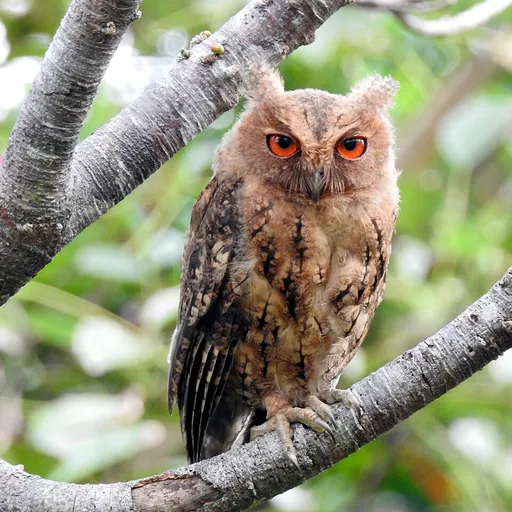
Japanese Scops Owl
Otus semitorques
Least Concern
Overview
The Japanese scops-owl (Otus semitorques) is a small owl in the true owl family, Strigidae, and a member of the scops owl genus. It is a resident species found across Japan, China, Korea, and Russia.
Identification
- Otus semitorques measures 16.5–30 cm in height with a wingspan of 60–66 cm and a weight between 130–200 g.
- Plumage is grey and brown, resembling tree bark for camouflage, featuring a pale grey-brown facial disc, intense red eyes, a green bill, and green feet with feathered toes.
- Prominent ear tufts are visible, consistent with most scops owls.
- Vocalizations include screeches, meows, hoots, chatters, and repeated deep "whook" calls, as well as "kwe," "koo," "kwee-kwee," and "pew-u, pew-u" sounds.
Habitat
Japanese scops-owls inhabit forested environments such as lowland forests, wooded plains, forested hillsides, woodlands, and mountains, as well as parks and gardens in villages. Their range extends from sea level up to 900 meters elevation. They are resident to Japan, Korea, China, and Russia, with three recognised subspecies covering specific regions within these countries.
Diet
Primarily carnivorous, they feed on invertebrates such as insects, millipedes, centipedes, and crustaceans, as well as small rodents like voles and mice. They also consume small birds, frogs, lizards, snakes, and fish. As active predators, they mostly forage by flying but will sometimes perch to hunt, relying on auditory cues to detect prey in open areas during their nocturnal hours.
Did you know?
Females select their mate based on the male's nest-building skills and the amount of food he has provided, and males often reuse old nests belonging to other bird species.
Sources
- Wikipedia · CC BY-SA 4.0
- Wikidata · CC0 1.0