
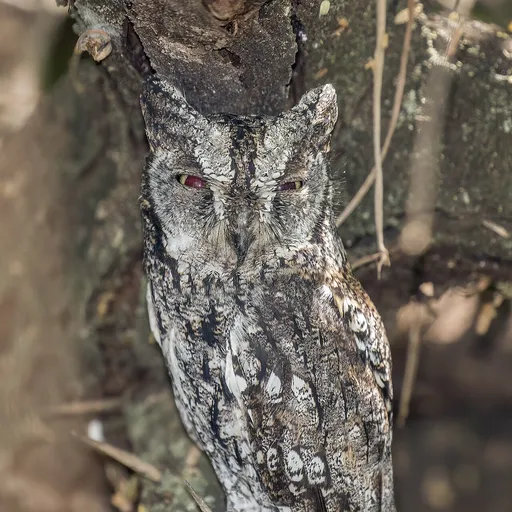
African Scops Owl
Otus senegalensis
Least Concern
Overview
The African scops owl (Otus senegalensis) is a small owl species widespread across sub-Saharan Africa. Listed as Least Concern on the IUCN Red List, it is one of 58 scops owls within the genus Otus. It was formally described in 1837 by William Swainson based on a specimen collected in Senegal.
Identification
- Measures 15–17 cm in length with a 45 cm wingspan and is typically greyish-brown, pale rufous, or warm brown with cryptic streaks and mottling.
- Features a grey facial disk with a narrow black edge and yellow eyes, possessing ear tufts that are generally kept lowered unless disturbed.
- Emits a monotonous, quivering "prrrp" call at five-second intervals.
Habitat
Endemic to sub-Saharan Africa, this species ranges from sea level to 2,000 m in elevation. It inhabits wooded areas and forest edges, including mangroves and gardens.
Diet
The primary diet consists of insects such as grasshoppers, beetles, crickets, and moths, along with spiders, scorpions, and small vertebrates. It forages by scanning or listening from a perch before swooping down to capture prey on the ground, though it will hawk flying insects.
Did you know?
When roosting in daylight, the owl closes its eyes and extends its ear tufts to mimic the appearance of a tree branch, making it easily overlooked. Pairs sometimes roost together during the day.
Sources
- Wikipedia · CC BY-SA 4.0
- Wikidata · CC0 1.0