
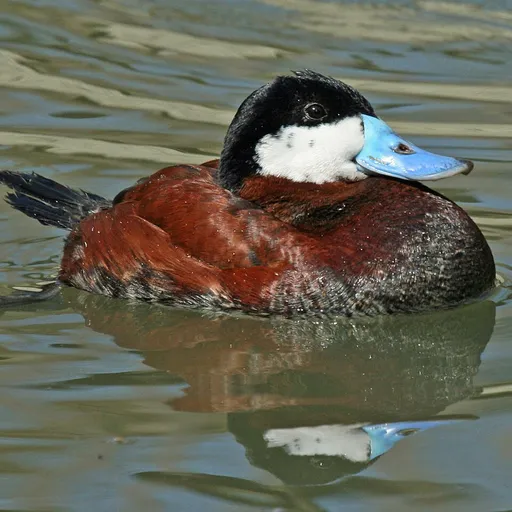
Ruddy Duck
Oxyura jamaicensis
Least Concern
Overview
The ruddy duck (Oxyura jamaicensis) is a small, compact species of stiff-tailed duck native to the Americas, though it was introduced to the United Kingdom in the 1940s and subsequently spread across Europe. Outside its native range, it is classified as a highly invasive species, prompting culling efforts to protect native wildlife such as the endangered white-headed duck.
Identification
- Small, compact body with a short, thick neck and a long, stiff tail held cocked upward.
- Stout, scoop-shaped bill that is bright blue in breeding males and dull gray in winter or on females.
- Breeding males feature a rich chestnut body, blackish cap, and bright white cheeks; non-breeding plumage is dull gray-brown above and paler below.
- Males produce a distinct drumming sound known as 'bubbling' by beating their lower mandible on their breast, often creating swirls of bubbles.
Habitat
Ruddy ducks breed in marshy lakes and ponds, nesting in dense vegetation to hide from predators. They are migratory and winter in coastal bays and unfrozen lakes or ponds. Originally from the Americas, the species established an invasive population in the United Kingdom in the 1940s, leading to its spread throughout Europe.
Diet
The ruddy duck feeds primarily on plant matter such as seeds and roots, as well as aquatic insects, crustaceans, and small molluscs. Foraging occurs underwater, where the bird strains food from the substrate by moving its bill side to side, relying on tactile sensing rather than sight due to clouded water conditions.
Did you know?
Ruddy ducks are nicknamed 'butterball' due to their short and stout stature, which makes activities like flying and walking upright awkward. Despite rarely flying, when they do take off, it is with a very fast wingbeat closely over the water.
Sources
- Wikipedia · CC BY-SA 4.0
- Wikidata · CC0 1.0